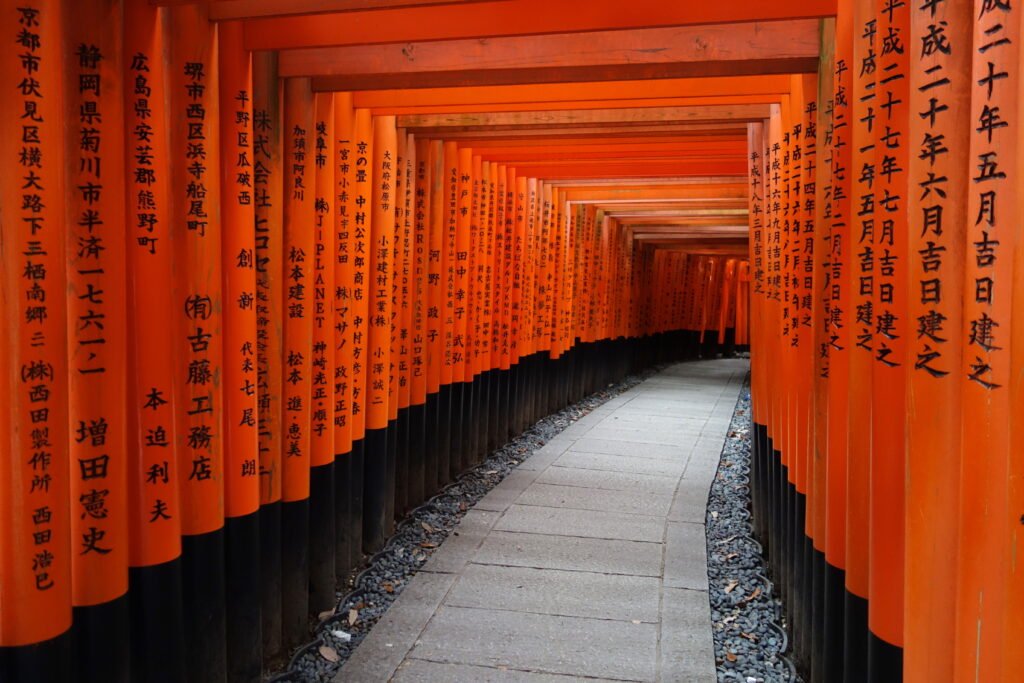
How long to spend at Fushimi Inari? Give it 45 minutes if you only want the famous tunnel-of-gates photos, 1 to 1.5 hours to climb to the Yotsutsuji viewpoint halfway up, and 2 to 3 hours for the full loop over the 233-metre summit of Mt. Inari. Entry is free, the grounds never close, and the nearest station drops you practically at the front gate — so the real question isn’t whether you have time, but how much of the mountain you want.
Most visitors see only the bottom tenth of the place. They photograph the Senbon torii, buy a charm, and leave — never realising there’s a forested mountain trail above them with shrines, viewpoints and long stretches where you’ll have the path to yourself. This guide breaks down the three ways to do it so you can match your visit to your schedule.
Table of Contents
Quick facts
| Location | Fushimi Ward, southern Kyoto |
| Nearest station | JR Inari Station (Nara Line) — right outside the gate |
| Alternative station | Keihan Fushimi-Inari Station — about 5 minutes on foot |
| Admission | Free |
| Hours | Grounds open 24 hours, every day |
| Time needed | 45 minutes to 3 hours, depending on your route |
| Summit | Mt. Inari, 233 m |
| Best time to visit | Early morning, before 8 am |
| UNESCO World Heritage site? | No — despite what some tour listings claim (see FAQs) |
Getting there
The easiest approach is the JR Nara Line from Kyoto Station to JR Inari Station — about 5 minutes and around ¥150. Take a local train: rapid services skip Inari entirely, which catches out a lot of first-timers. IC cards (Suica, Pasmo, ICOCA and the rest) all work — just tap in and out.
The alternative is the Keihan Main Line to Fushimi-Inari Station, roughly a 5-minute walk to the shrine approach. This is the better option if you’re coming from Osaka, with direct Keihan trains from the Yodoyabashi and Temmabashi area.
Whichever you choose, navigation is trivial. JR Inari’s exit faces the shrine’s approach street directly — walk out, cross the road, and you’re among the food stalls with the great Romon gate ahead of you. From the Keihan station, follow the signs uphill for a few minutes.
One honest note: don’t overthink the transport. Fushimi Inari sits about five minutes south of Kyoto Station, so it slots into almost any Kyoto day. The classic pairing is Uji — continue south on the JR Nara Line for Byodoin Temple and matcha — or head back north toward Toji Temple and Kyoto Tower.
Three ways to visit, from 45 minutes to 3 hours
Option 1: The lower shrine and Senbon torii (under 1 hour)
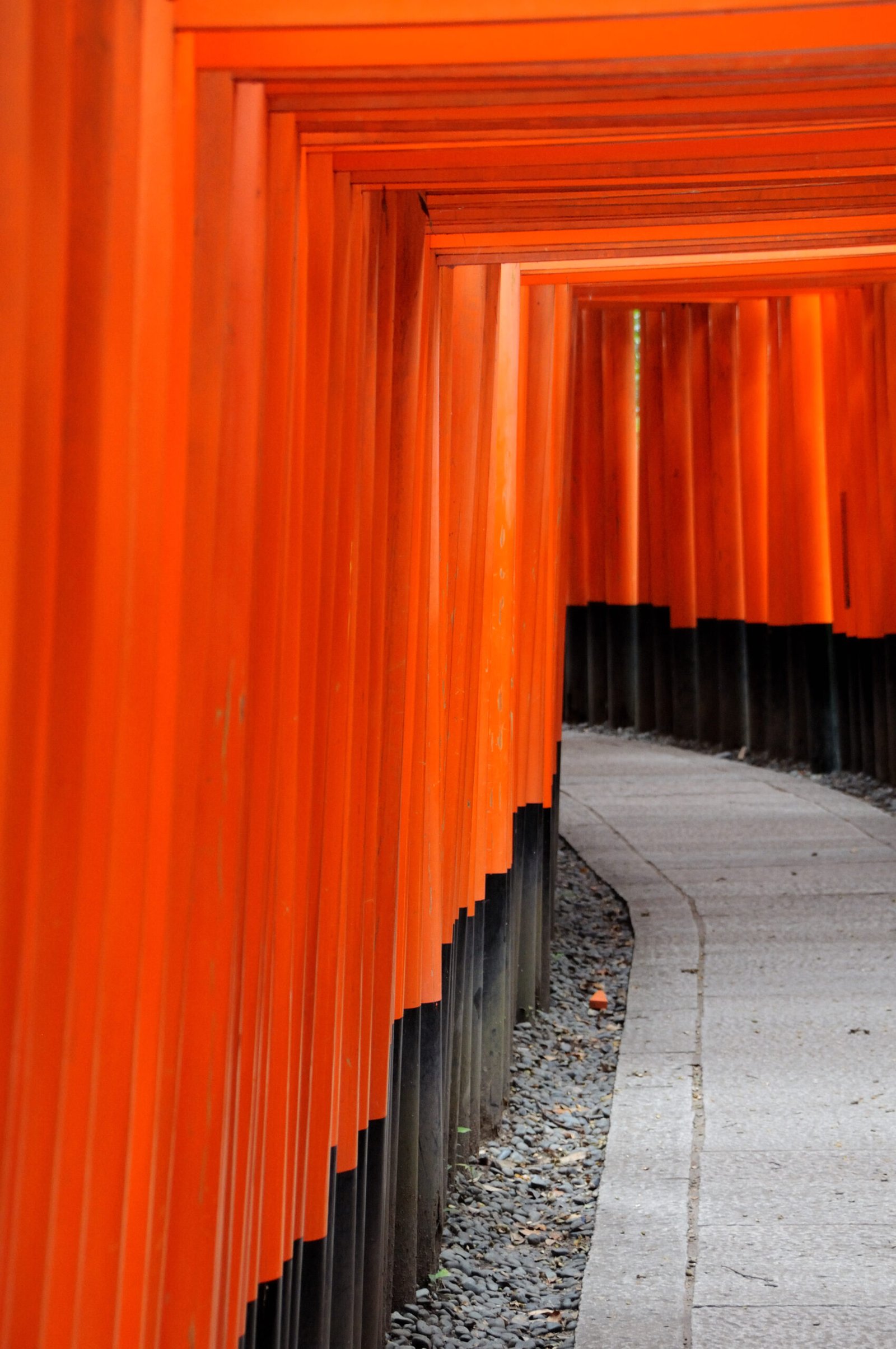
Enter through the Romon gate, pass the main worship hall, and head for the famous Senbon torii — the “thousand torii gates” — directly behind it. Two parallel tunnels of vermilion gates run uphill here, each gate donated by a business or individual praying for prosperity (read the black inscriptions: company names, dates, wishes). This dense section is what fills every postcard, and you can walk it in 20–30 minutes at a photo-taker’s pace.
Just past the tunnels sits Okusha Hohaisho, the inner shrine, fronted by rows of miniature torii stacks left as offerings and guarded by stone foxes — kitsune, the messengers of Inari. The fox statues here are worth a proper look: each holds something different in its mouth (a key, a scroll, a jewel), and no two are quite alike.
If your schedule is tight, this loop — main hall, Senbon torii, inner shrine, back down — is completely satisfying. But know that you’ve seen the appetiser, not the meal.
Option 2: Up to the Yotsutsuji viewpoint (1–1.5 hours)
Keep climbing past the inner shrine and the crowds thin fast. The path splits and rejoins through seemingly endless ranks of smaller gates, and after 30–40 minutes of steady uphill walking you reach Yotsutsuji, the four-way intersection roughly halfway up the mountain.
This is the payoff most day-trippers are after: a broad terrace with a sweeping view south over Kyoto. There are tea houses and rest spots here — stop for amazake (sweet sake) or a soft-serve and watch the city. On a clear day the view stretches for miles; at dusk, the city lights come on below you. Allow an hour to 90 minutes round trip from the base at a comfortable pace.
Option 3: The full Mt. Inari loop (2–3 hours)
From Yotsutsuji, continue to the 233-metre summit area — Ichinomine (the upper shrine) — then loop around the mountain’s far side and descend. This is where Fushimi Inari becomes a genuine walk: cedar forest, mossy stone lanterns, dozens of tiny sub-shrines, and long quiet stretches where the only sound is crows and your own footsteps.
The full circuit takes most people 2 to 3 hours round trip including photo stops. It’s almost entirely steps and paved path — not difficult, but it is a real climb, and you’ll feel it in your calves the next day. Fewer than one in ten visitors go this far, which is exactly why you should.
Practical details
Entry to the shrine is free and the grounds are open 24 hours. The shrine offices, charm counters and shops keep normal daytime hours, but nobody will stop you walking the mountain at dawn or after dark.
The approach street is half the fun: stalls selling inari sushi (sweet fried tofu pouches — the dish is named after the god Inari himself), yakitori, grilled mochi and regional sweets. Eat before you climb or after you descend; there are also tea houses at Yotsutsuji and near the summit.
Toilets are available near the base and at points up the mountain. For photography, the etiquette is simple: keep moving in the narrow gate tunnels, don’t block the path for tripod setups during busy hours, and remember people are here to pray — keep your voice down around the altars.
Seasonal notes
Fushimi Inari is a year-round destination, but timing shapes the experience enormously.
- New Year (hatsumode): the first three days of January bring staggering crowds — hundreds of thousands of visitors. Go only if the festival atmosphere is the point; otherwise avoid.
- Spring: cherry blossom season is busy but the mountain paths are lovely, with blossoms scattered among the gates.
- Summer: Kyoto is brutally humid. Go at dawn, bring water, and know the forested upper trail is mercifully shaded. Evenings are atmospheric under the lanterns.
- Autumn: arguably the best season — comfortable temperatures and autumn colour on the mountain slopes.
- Rain: don’t cancel for light rain. The wet vermilion gates photograph beautifully and the crowds evaporate.
What to bring
- Comfortable walking shoes — the full loop is a proper trail with long flights of steps
- Water, especially in summer (vending machines thin out above Yotsutsuji)
- A camera or phone with good low-light performance for the gate tunnels
- Small coins for offerings at the sub-shrines
- A light rain shell — Kyoto weather turns quickly
Where to stay
You don’t need to stay near Fushimi Inari — it’s five minutes from Kyoto Station, so base yourself wherever suits your wider itinerary. The area around Kyoto Station (south Kyoto) makes the shrine an easy early-morning trip before the crowds, which is exactly the strategy we recommend. It’s equally doable as a half-day trip from Osaka via the Keihan Line, or combined with Nara and Uji along the JR Nara Line corridor.
Our tips
Whatever hour you visit, the advice is consistent:
- Arrive before 7:30 am. The difference between the Senbon torii at 7 am (empty, silent, magical) and at 10 am (a shuffling queue) is the difference between two different places.
- Do the full loop. Almost everyone turns back at Yotsutsuji. The summit forest — moss, lanterns, tiny shrines, nobody around — is the best part of Fushimi Inari and most visitors never see it.
- Eat inari sushi on the approach. It sounds touristy; it isn’t. The dish is literally named for this god, and the shops here have been perfecting it for generations.
- Look at the gate inscriptions. Dates, company names, personal wishes — the gates are a century-deep archive of Japanese hopes. The oldest ones are weathered nearly black.
- If it drizzles, go anyway. Wet stone, deep red gates, no crowds — some of the best photos of Fushimi Inari ever taken were shot in light rain.
- Consider an evening visit. After about 5 pm the day crowds thin out, lanterns glow along the lower paths, and the upper mountain goes completely quiet. The main paths are lit enough to walk safely, and the atmosphere is entirely different from midday.
- Say hello to the foxes. The kitsune statues guarding the shrines aren’t decoration — they’re Inari’s messengers, and each holds something symbolic: a key, a scroll, a sheaf of rice. Spotting the variations as you climb is a free treasure hunt, and kids love it.
FAQs
How long should I spend at Fushimi Inari?
45 minutes covers the main shrine and the famous Senbon torii tunnels. Allow 1 to 1.5 hours to reach the Yotsutsuji viewpoint, or 2 to 3 hours for the full loop over Mt. Inari’s 233-metre summit. If photography matters to you, add 30 minutes to any of those.
Is Fushimi Inari a UNESCO World Heritage site?
No — and this is worth saying clearly, because several tour-booking sites falsely describe it as one. Kyoto has many genuine UNESCO-listed sites, but Fushimi Inari Taisha is not among them. Its fame needs no borrowed credentials.
Is entry really free?
Yes. There is no admission fee, and the shrine grounds are open 24 hours a day, every day of the year. You’ll only spend money on food, charms and offerings if you choose to.
What’s the best time of day to visit?
Early morning — ideally before 8 am — for crowd-free photos in the torii tunnels. Late afternoon into evening is the second-best window: the day-trip crowds leave and the lantern-lit paths turn atmospheric.
Can I visit at night?
Yes, the grounds never close. The lower paths are lit by lanterns and feel safe and atmospheric; the upper mountain is dark, so bring a phone light or headlamp if you climb after sunset, and go with a companion.
Is it suitable for kids or older visitors?
The lower shrine and Senbon torii are flat, paved and easy for all ages. The mountain loop is a genuine walk with long staircases — older visitors and small children can simply turn back at Yotsutsuji and still see the famous viewpoint.
The bottom line
So, how long to spend at Fushimi Inari? However long you give it, spend it deliberately: 45 focused minutes beats three distracted hours. But if your schedule allows, take the full 2 to 3 hours and walk the whole mountain — the quiet forest above the crowds is the Fushimi Inari most visitors miss, and it’s the part you’ll remember. If you’re building a wider hiking itinerary for Japan, our best one-day hikes in Japan rounds up proper trails worth pairing with it.
