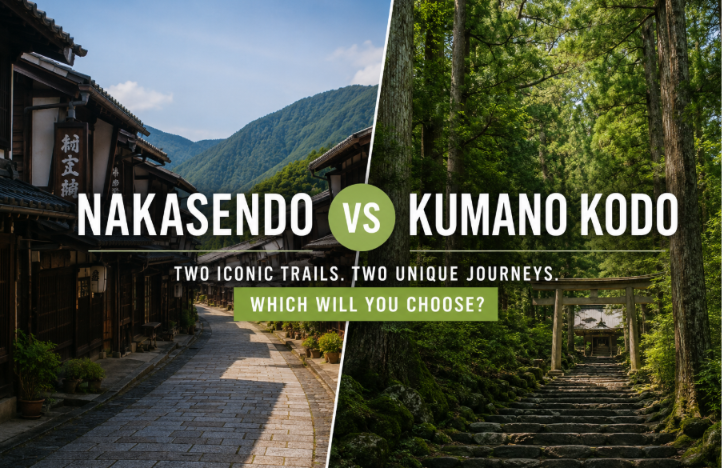
Japan has many beautiful walking paths but many travelers compare between the Nakasendo Trail and the Kumano Kodo before choosing one. Both paths have amazing views, rich history and a unique experience, but they are very different from each other.
Some people enjoy the peaceful villages and old roads of the Nakasendo path while others would love to experience the amazing forests, temples and spiritual places of the Kumano Kodo.
If your question was Nakasendo vs Kumano Kodo then by the end you will understand which is better according to your needs in a simple way based on some factors like scenery, history, difficulty, hiking experience and more so you can decide which trail is the better choice for your trip.
Table of Contents
What Is the Nakasendo Trail?
Before comparing Nakasendo vs Kumano Kodo it is important to know about each path clearly.
The Nakasendo Trail was an important road during Japan’s Edo period. It connected Kyoto and Edo (now called Tokyo). Merchants, samurai, government officials and other travelers used this path to travel between the two cities.
Along the full Nakasendo route there were 69 towns where people could rest, eat and stay for the night.
But now the Nakasendo path is famous for its well-known and beautiful villages like Magome, Tsumago, Narai and Kiso-Fukushima. While walking on this path, the villages in between make you feel like you are going back in time. You will see traditional wooden buildings, old stone paths and beautiful mountain views. It’s a great choice if you enjoy history, culture, and peaceful walks.
Read more: How Long Does It Take to Hike the Nakasendo Trail? Route & Walking Time Guide
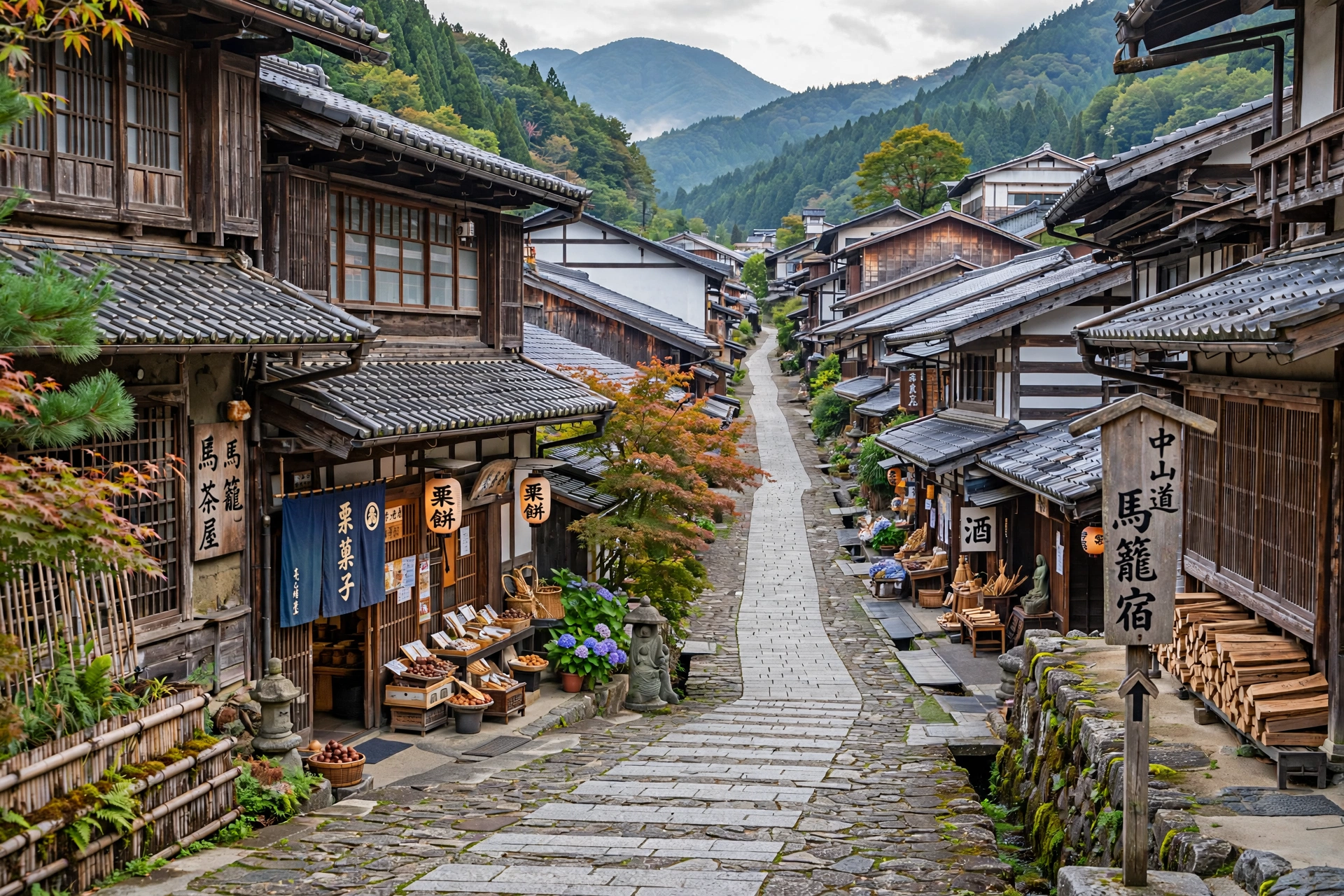
If you enjoy history, old villages and easy walking paths then the Nakasendo Trail is a great choice. Some of the ancient places are still there with the beautiful scenery and friendly local people. They can help you see what Japan was like hundreds of years ago. You can enjoy the journey without needing a lot of hiking experience.
If you love peaceful forests, holy places and a bigger hiking adventure then the Kumano Kodo is the better choice. Walking the same paths that people have used for hundreds of years makes the journey feel special and unforgettable.
You will have an amazing experience on both trails. Nakasendo vs Kumano Kodo is not about which trail is better. It is about choosing the one that matches your interests. Both trails show a different side of Japan’s history, culture and natural beauty. Either way, both trails will give you an unforgettable experience.
What Is the Kumano Kodo?
The Kumano Kodo is a network of pilgrimage routes crossing the Kii Peninsula, leading to the Kumano Sanzan, the Three Grand Shrines of Kumano: Hongu Taisha, Nachi Taisha, and Hayatama Taisha.
Pilgrims have walked these mountain paths since the Heian period, over a thousand years ago. Emperors undertook the journey seeking spiritual purification; the retired Emperor Go-Shirakawa reportedly completed it more than thirty times. Where the Nakasendo served commerce and administration, the Kumano Kodo served the spiritual life.
In 2004, UNESCO inscribed it as a World Heritage site. It shares a rare distinction with Spain’s Camino de Santiago as one of only two pilgrimage routes in the world holding UNESCO status. Walkers who complete qualifying sections of both earn the title of Dual Pilgrim, a programme the Tanabe City tourism bureau officially launched on February 1, 2015.
The most travelled route is the Nakahechi, the middle route, running approximately 70 kilometres through forested mountains. The Nakahechi includes days exceeding 1,000 metres of climbing, and the Koguchi to Nachi section gains 1,120 metres over its highest pass. Other routes run harder still: the Kohechi crosses four passes above 1,000 metres, and the remote Omine Okugake follows ridges where Shugendo ascetics have trained for centuries.
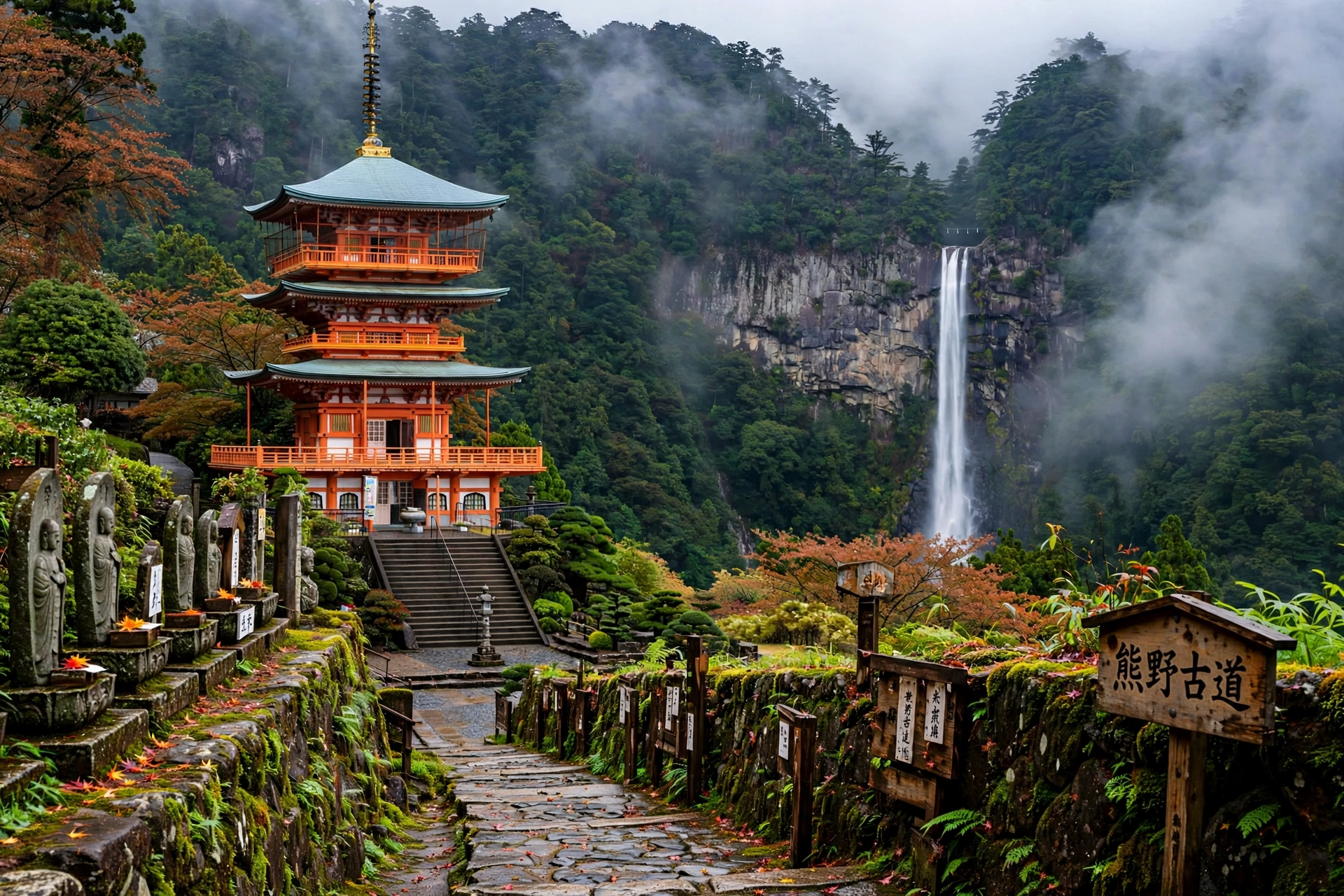
Nachi Falls drops 133 metres in a single uninterrupted tier, the tallest single-drop waterfall in Japan, with the pagoda of Seiganto-ji framed against it. Yunomine Onsen, among Japan’s oldest hot spring villages, served pilgrims long before the shrines formalised the route. The Daimonzaka, a 600-metre stone staircase ascending through ancient cedars to Nachi Taisha, ranks among the most atmospheric sections of either trail.
Nakasendo vs Kumano Kodo: Quick Comparison
The Nakasendo is a walk through feudal social history. Travellers move between preserved post towns, sleep in centuries-old inns, and eat through the Kiso Valley. The walking is gentle to moderate, logistics are straightforward, and the well-known Magome to Tsumago section works as a day trip from Nagoya.
The Kumano Kodo is a walk through spiritual history. Travellers climb forested mountain passes between small villages, visit thousand-year-old shrines, and bathe in hot springs used by pilgrims for centuries. The walking is moderate to challenging, logistics require more planning, and the Nakahechi deserves four to six days.
These trails offer fundamentally different experiences. The relevant question is not which is better, but which experience suits the traveller.
History of Nakasendo vs Kumano Kodo
The Nakasendo flourished during the Edo period as one of the five great highways connecting Edo and Kyoto. Its 69 post stations served daimyo processions travelling under the sankin-kotai system, alongside merchants, messengers, and ordinary travellers. The inland route avoided the river crossings required on the coastal Tokaido.
The Kumano Kodo is older. Its roots reach into the Heian period, when the imperial court embraced the Kumano faith, a syncretic blend of Shinto and Buddhism centred on nature worship. Mountain ascetics known as yamabushi trained in these forests, holding that physical hardship purified the spirit. The journey itself constituted the ritual.
A detail many guides omit: the Kumano pilgrimage welcomed everyone. Men and women, aristocrats and peasants, the able-bodied and the infirm. In medieval Japan, that inclusivity was remarkable.
Travellers will also encounter the Yatagarasu along the route, the three-legged crow of Japanese mythology said to have guided the legendary first emperor through these mountains. It appears on talismans, signs, and souvenirs, and forms half the Dual Pilgrim badge alongside the Camino scallop shell.
Scenery Comparison
On the Nakasendo, the scenery is cultural landscape: terraced post towns with dark wooden facades, stone-paved paths through bamboo and cedar, waterfalls beside the trail, and the Kiso River threading the valley. The Magome to Tsumago walk concentrates this into under four hours. Narai, the longest post town on the route at nearly a kilometre of preserved streetscape, and the climb over Torii Pass show the Kiso Valley as it appeared when this road mattered.
On the Kumano Kodo, the scenery is primeval. Towering cedar and cypress close overhead, moss covers the forest floor, and mist drifts through valleys little changed in a thousand years. The Nakahechi alternates between ridgelines and river valleys, opening onto shrine clearings and waterfall basins. Nachi Falls, at 133 metres, commands attention.

One practical note: the Kii Peninsula is among the wettest regions in Japan. Rain should be treated as expected rather than possible. In summer, leeches appear on forest trails.
Hiking Difficulty
The Nakasendo suits regular walkers. The Magome to Tsumago section takes two and a half to three and a half hours with modest climbing; the recommended direction descends more than it ascends. The steepest challenge on the popular Kiso sections is Torii Pass between Yabuhara and Narai. Families manage this trail comfortably.
The Kumano Kodo demands more. The Nakahechi, considered the easiest Kumano route, includes multiple days with 600 to 1,000 metres of ascent. The Koguchi to Nachi day climbs 1,120 metres over its highest pass and takes six to seven hours. Casual walkers should consider shorter sections: Hosshinmon-oji to Hongu is mostly downhill at about three hours, and the Daimonzaka stone steps provide a half-day introduction.
In short: the Nakasendo offers pleasant walking with cultural stops; the Kumano Kodo offers physical challenge within a spiritual setting.
Cultural Experience
The Nakasendo immerses travellers in Edo-period daily life. Accommodation in minshuku inns, some centuries old; regional specialities such as gohei-mochi and soba; streets where the buildings themselves serve as the museum. The experience is social and tangible: shopkeepers, fellow walkers, warm baths, good food.
The Kumano Kodo immerses travellers in something older and quieter. The oji shrines, small subsidiary shrines along the Nakahechi, mark a pilgrimage logic without parallel on the Nakasendo. Each served as a waypoint for prayer, and passing them in sequence reproduces a spiritual rhythm repeated for a millennium. The hot springs carry meaning as well: pilgrims purified themselves at Yunomine Onsen before approaching the shrines, making the bath part of the ritual rather than mere recovery.
The two experiences operate on different frequencies, and many travellers complete both in different years.
Which Trail Is Right for You?
Choose the Nakasendo for gentle walking, historic towns, straightforward logistics, and strong regional food. It serves well as a first Japan hiking experience, a family trip, or a two to five day cultural walk. Base in the Kiso Valley, walk Magome to Tsumago, add Narai and Torii Pass with more days, and forward luggage between inns.
Choose the Kumano Kodo for mountain walking, spiritual atmosphere, and genuine physical challenge. It suits experienced hikers, pilgrimage enthusiasts, and those pursuing the Dual Pilgrim goal. Allow the Nakahechi four to six days, book accommodation months ahead for spring and autumn, and prepare for rain regardless of forecast.
A practical tiebreaker: the Nakasendo is easier to shorten mid-trip. Post towns sit on the JR Chuo Line, allowing exit at any station. The Kumano Kodo commits travellers to mountain villages with limited transport, which forms part of its character and part of its demand.
Our Short Version: Which Trail We Would Walk First
If this is your first Japan walking trip, we would start with the Nakasendo. It is gentle, the logistics are simple, and this guide notes it is easy to shorten because the post towns sit on the JR Chuo Line. We would save the Kumano Kodo for when we could give it four to six days on the Nakahechi, book lodging months ahead for spring or autumn, and expect rain whatever the forecast says.
| If you want… | We would choose | Why |
|---|---|---|
| A gentle first walk, a family trip or 2–5 days | Nakasendo | Magome to Tsumago takes about 2.5 to 3.5 hours with modest climbing |
| Mountain walking and a pilgrimage atmosphere | Kumano Kodo | The Nakahechi is about 70 km, with days of 600 to 1,000 m of ascent |
| A taste of Kumano without the commitment | Short Kumano sections | Hosshinmon-oji to Hongu is mostly downhill at about three hours, and the Daimonzaka steps are a half-day |
For trail lengths and timings, see our guides on how long the Nakasendo takes and how long the Kumano Kodo is, and for the pilgrimage side, our Kumano Kodo pilgrimage guide.
