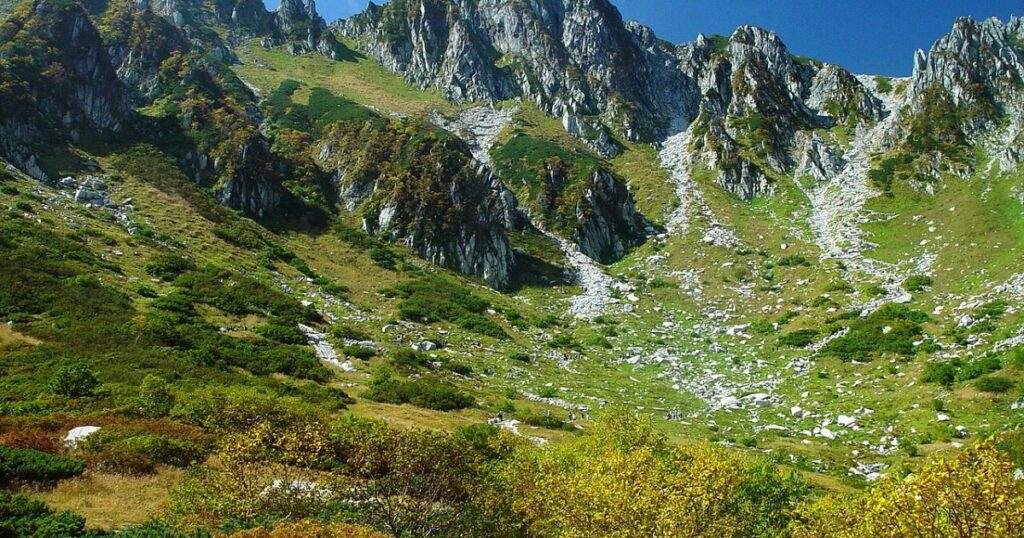
There are places in Japan where the mountain comes to you, and then there are places where you have to earn every metre of it. Senjojiki Cirque is the first kind, and that is exactly what makes it so easy to misunderstand. You step out of a cable car, and there it is: a vast, grassy bowl ringed by granite walls, with a jagged peak towering over it and alpine flowers at your feet. It looks gentle. It looks like a park. And in one sense it is — a paved loop, a hotel, a café, and a shrine, all sitting at 2,612 metres above sea level.
But look a little longer, and the place starts to tell a different story. That bowl was carved by a glacier some 20,000 years ago. The peak above it, Mount Hokendake, is a knife-edge ridge with chains and fixed ladders. Behind it, hidden from the cirque floor, stands Mount Kiso-Komagatake at 2,956 metres, the highest mountain in the Central Alps. And the bird that lives on the ridge above you — the rock ptarmigan, or raicho — was extinct here for more than fifty years before people brought it back. Senjojiki Cirque is a day out and a serious alpine landscape at the same time, and the trick is to enjoy the first without forgetting the second.
This guide is written in the spirit of the Outdoor Japan Guide About Us page. As the founder, Amit Patra, writes there: “I’m an enthusiast, not an expert. I share what I learn about Japan’s outdoors through careful research, and I try to be honest about what I know and what I don’t.” That is the approach here. The fares, times, routes and seasons below come from official and published sources — Chuo Alps Kanko, the Japan National Tourism Organization, Go! Nagano and Japanese hiking guides — and where those sources disagree on a number, this guide says so instead of picking the tidiest one. It is not a guided tour, and the author does not claim a personal ascent of every route here. Mountain conditions change quickly, so treat this as your starting point and confirm the latest bus, ropeway and weather details before you go.
Below you will find the ropeway explained properly, the step-by-step route from Tokyo and Komagane, the honest truth about fares and queues, the 45-minute loop, the summit climb, and the small details that catch first-timers out — the ticket that does not guarantee a ride, the autumn colours that arrive two weeks early, and the peak in every photograph that is not the main summit at all. Read it through before you book anything, and the cirque will make far more sense when you finally stand in it.
🥾 Senjojiki Visit: Quick Summary
Everything from the guide below, condensed — plus a few things most guides skip.
📊 Hike Summary
Cirque floor
2,612 m
Cirque loop
~1 km, 40–60 min
Summit climb
~3.6–3.9 km, 3–4 hrs
Difficulty
Easy🚌 Getting There
Take the route bus from Komagane Station (about 50 min) or Suganodai Bus Center (about 30 min) to Shirabidaira, then the Komagatake Ropeway up to 2,612 m in about 7 minutes 30 seconds. Private cars cannot drive to Shirabidaira.
- Park at the Suganodai Bus Center (¥800 a day, 300 spaces) — past Suganodai the mountain road is closed to private vehicles all year round.
- The ropeway can be suspended in severe weather, and the bus route can close under rainfall regulations — check the operator’s site on the morning you travel.
- From Tokyo, the highway bus from Shinjuku to Komagane IC takes about 4.5 hours; the train via Okaya and the Iida Line takes about 5.5 hours.
- Catch the ropeway down at least one hour before the last route bus leaves — miss that bus and you are looking at a taxi.
🧭 Choose Your Trail
Cirque Loop Walk
The classic visit: a paved 40–60 min loop past Komagatake Shrine to Kengaike Pond and back past Hotel Senjojiki. No hiking experience needed.
Mount Kiso-Komagatake
The 2,956 m summit via Hatchozaka and Norikoshi Jodo — about 3.6–3.9 km round trip, 3–4 hours. The highest peak in the Central Alps.
Mount Hokendake
The jagged 2,931 m spire above the cirque — chains, ladders and an exposed ridge. Advanced climbers only; most visitors admire it from below.
Do not judge this place by the easy-looking loop. The ropeway puts you at 2,612 m in minutes, with no time to acclimatise — spend 30 minutes on the cirque floor before climbing, and keep the summit as a turn-back decision, not a promise.
📅 When to Hike
🌤️ Weather Check
🎒 What to Pack
💡 Good to Know Before You Go
Elevation
0 m
Location
Komagane, Nagano Prefecture
Belongs to
Chuo Alps Quasi-National ParkTable of Contents
- What Is This Bowl — and Why It Looks Like That
- At a Glance: The Numbers That Matter
- The Komagatake Ropeway: Japan's Highest, Steepest Climb
- Getting There Step by Step
- Fares, Tickets and the Crowd Problem
- The 45-Minute Cirque Loop: Step by Step
- Climbing Mount Kiso-Komagatake from the Cirque
- Mount Hokendake: The Peak to Admire, Not to Rush
- Alpine Flowers, Wildlife and the Ptarmigan Comeback
- Best Season: Flowers, Autumn Colour, Snow and Silver Frost
- Hotel Senjojiki and Staying Overnight at 2,612 Metres
- What to Pack
- Safety, Altitude and Weather
- What Competitor Guides Miss
- A Sample Day Plan
- Frequently Asked Questions
- Final Thoughts
What Is This Bowl — and Why It Looks Like That
First, the word itself. A cirque is a bowl carved into a mountainside by a glacier, and Senjojiki is one of the finest examples in Japan. Around 20,000 years ago, during the last ice age, a glacier ground its way down the eastern side of the Kiso Range and scooped out a near-perfect amphitheatre in the granite. The walls rise nearly 300 metres above the floor, the drainage runs out of one side and tumbles down a series of waterfall steps, and the bottom of the bowl still holds the terminal moraines — the ridges of rock the glacier left behind when it melted. It is, in the words of the Forestry Agency, a landform of tremendous scientific value, and it is designated a natural monument by Nagano Prefecture.
Then, the name. Senjojiki means "a thousand tatami mats", and it describes the size of the cirque floor: imagine a thousand tatami mats laid edge to edge, and you have the scale of the place. Some Japanese guides estimate the floor is actually closer to 2,000 mats, and the figure of a thousand is poetic rather than measured — but the name has stuck for generations, and it tells you what the first people who named it felt standing there. It is big, open, and strangely flat for a place at 2,600 metres.
Finally, the setting. Senjojiki Cirque sits in the Kiso Mountains, better known as the Central Alps, in Komagane City, Nagano Prefecture, inside the Chuo Alps Quasi-National Park. It is a designated special conservation area, which is why parts of the floor are roped off and why you should stay on the path even when the flowers tempt you closer. The Central Alps are the quiet middle child of the Japan Alps: the Northern Alps get Kamikochi, the Southern Alps get the long ridge walks, and the Central Alps get one ropeway, one hotel, and a landscape that most overseas visitors never hear about. That is part of the appeal. You are not queuing behind a tour group here — at least, not on a weekday.
One thing worth clearing up early is the geography of the peaks around you. The jagged grey spire that fills every photograph is Mount Hokendake, at 2,931 metres. It looks like the main peak because it stands closest and rises most steeply. It is not. The main peak, Mount Kiso-Komagatake, is hidden behind Hokendake from the cirque floor, and it is the rounded, higher summit you reach after climbing past the col. Keep that distinction in mind, because several English guides blur the two together, and it changes how you plan the day.
Senjojiki Cirque at a Glance
Before the detail, here are the figures that shape every decision on this trip — and one honest warning about them. Ropeway fares change with the date, hiking times change with the measurer, and the weather at 2,612 metres changes with the hour. The numbers below are the ones to plan on, and where sources disagree, the range is given rather than a single tidy figure.
- Cirque floor: about 2,612 m, at Senjojiki Station
- Ropeway: Shirabidaira (1,662 m) to Senjojiki (2,612 m) — a 950 m climb in about 7 minutes 30 seconds
- Ropeway opened: 1967, the first mountain ropeway built in Japan
- Cirque loop: about 1 km, 40–60 minutes at an easy pace
- Summit climb: about 3.6–3.9 km round trip to Mount Kiso-Komagatake (2,956 m), about 3–4 hours including breaks
- Mount Hokendake: 2,931 m — chains and exposed rock, advanced climbers only
- Best seasons: flowers mid-July to mid-August; autumn colour late September to early October
- Location: Komagane City, Nagano Prefecture, in the Central Alps (Kiso Range)
- Park: Chuo Alps Quasi-National Park, special conservation area
Why do the hiking numbers differ? The Japan Alps guide lists the Kiso-Komagatake round trip at roughly 3.5 km with about 490 metres of ascent and four hours including breaks. The Japan Alps route database lists 3.9 km, 448 metres and 3 hours 35 minutes. A more recent measured guide lists 3.6 km, 426 metres and 2 hours 45 minutes of walking time. None of these is wrong. The route is the same; the measuring is different, and walking time is not the same as elapsed time once you add photographs, rests and a queue at the summit marker. For planning, use the slower figure. If you finish faster, you have gained an hour. If you plan on the faster figure and the mountain is slow, you have lost one.
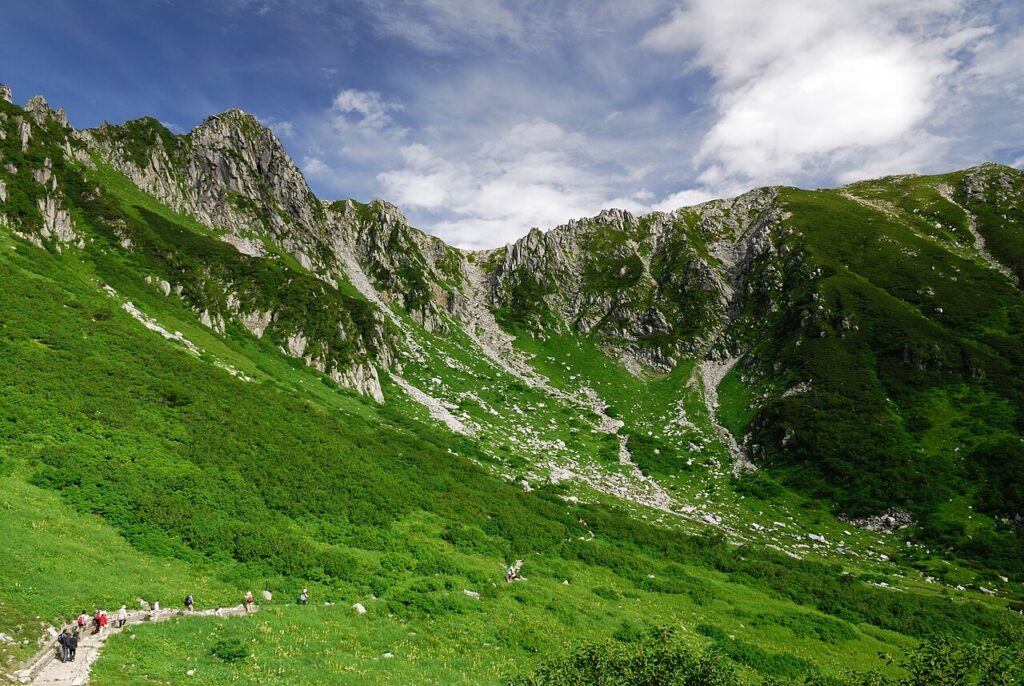
The Komagatake Ropeway climbs 950 metres in about seven and a half minutes — the largest height difference of any ropeway in Japan.
The Komagatake Ropeway: Japan's Highest, Steepest Climb
The ropeway is not just transport here. It is the experience that makes Senjojiki Cirque possible, and it holds two records that are worth knowing before you ride it. First, the top station at 2,612 metres is the highest ropeway station in Japan. Second, the 950-metre height difference between Shirabidaira and Senjojiki is the largest of any ropeway in the country. The cabin covers that climb in about seven and a half minutes, over a line 2,334 metres long. There is no other way to gain that much altitude in that much time anywhere in Japan, and very few places in the world match it.
It opened in 1967, and it was the first mountain ropeway built in Japan. The cabin holds 61 passengers, and the windows are big enough that everyone can see out. On a clear day you cross over the Hinokure Falls — the so-called 38-step waterfall — then climb past a narrow gorge section, and approach the top station with the sheer face of Mount Hokendake filling the upper window. About two-thirds of the way up, the cabin clears a near-vertical rock face. If you are scared of heights, that is the worst minute of the ride, and it is short. If the air is dry, look south on the way up: Mount Fuji is visible, faintly, on the southern horizon, which is one of the unexpected pleasures of the line.
There is no walk-up to the cirque, and no warm-up valley. Private cars cannot drive to Shirabidaira at all — the mountain road between Kurokawadaira and Shirabidaira is permanently closed to private vehicles, all year round. You park at the Suganodai Bus Center, ride the route bus for about 30 minutes up the gorge, and then step into the cabin. Seven and a half minutes later you are standing in the alpine zone. That suddenness is the whole point of the place, and it is also the main thing to respect about it: your body has had no time to adjust to the altitude, so take it slowly for the first half hour at the top.
A practical note on the ride itself. The ropeway runs all year round, but operations can be suspended in severe weather, and the bus route can be closed by rainfall regulations even when the valley looks fine. The operator posts suspension notices on its website the same day, so check the morning you travel. And if you are visiting in the autumn colour weeks, expect the ropeway to start as early as 6 a.m. on Saturdays and holidays, with extra services — and still expect a wait.
How to Get to Senjojiki Cirque
Getting to Senjojiki Cirque is a three-part journey — train or highway bus to Komagane, route bus to Shirabidaira, ropeway to the top — and each part has its own timetable. Here is how it works in practice, starting from the two places most overseas visitors come from.
Step 1: From Tokyo, take the highway bus if you can. The most efficient option is the highway bus from Shinjuku Busta to the Komagane Interchange stop, known as Nyotai-iriguchi, which takes about four and a half hours each way. There are many buses a day, with USB ports, free Wi-Fi, footrests and a toilet on board. From the interchange stop, a route bus runs to the Suganodai Bus Center and on to Shirabidaira. All told, Shinjuku to the cirque is around six hours including the ropeway. The operator also sells a combined ticket from Shinjuku that bundles the highway bus, route bus, ropeway and a hot-spring discount voucher — the simplest option if you are starting and ending in Tokyo on the same day.
Step 2: Or take the train, and accept that it is slower. The all-rail route is the JR Limited Express Azusa from Shinjuku to Okaya or Tatsuno, then the JR Iida Line south to Komagane Station, then the route bus to Shirabidaira. That is around five and a half hours each way and, by most published comparisons, more expensive than the bus. The Iida Line is single-track and slow, with fewer than 16 services a day, and IC cards do not work on it — so buy a paper ticket for the rail leg from your origin to Komagane to avoid an on-train fare adjustment. The train is the scenic choice, winding down the Tenryu River valley, but if time matters, the bus wins.
Step 3: From Nagoya or Osaka, use the highway bus. Buses run from the Meitetsu Bus Centre in Nagoya, about three hours each way, and from Osaka, about six and a half hours. Both stop at the Komagane Bus Terminal in town, from where you transfer to the route bus. If you are combining the cirque with Kanazawa, Takayama or Magome, the Nagoya bus is the practical pivot point. Magome and Tsumago are on the old Nakasendo road not far to the west, and they pair well with a Central Alps day — a mountain morning and a post-town afternoon is a very good use of two days.
Step 4: From Komagane Station, take the route bus — and leave time. The route bus from Komagane Station to Shirabidaira takes about 50 minutes. If you are driving, park at the Suganodai Bus Center, about three minutes by car from Komagane IC: parking is ¥800 a day for a regular car, with 300 spaces, and past Suganodai the road is closed to private vehicles. The bus from Suganodai to Shirabidaira takes about 30 minutes. The official advice, and it is worth following, is to catch the ropeway down at least one hour before the last route bus leaves — miss that bus, and you are looking at a taxi or a very long walk down a mountain road.
Step 5: Arrive early, especially in autumn. On autumn Saturdays the area around the Suganodai Bus Center is crowded from early in the morning, and the first buses leave as early as 5 a.m. in the peak colour weeks. A weekday, ideally a Tuesday or Wednesday, or the very first ascent of the day, are the two strategies that actually work. The Saturday-morning compromise — arriving at a comfortable hour and hoping the queue is short — is the one that does not.
Fares, Tickets and the Crowd Problem
Here is the part most English guides get wrong, so it is worth taking slowly. Ropeway fares at Senjojiki Cirque are not one price. They are banded by date, from A (most expensive) to E (cheapest), and the same round trip can cost very different amounts depending on when you go. The figures below were read from the operator's live Japanese fare page and its annual fare calendar on 15 November 2026, and they are given here as a planning guide — always confirm the current calendar before you travel, because the bands change every year.
The ropeway round trip, Shirabidaira to Senjojiki, runs from ¥2,290 for an adult on the cheapest E-fare days up to ¥3,050 on the most expensive A-fare days, with B at ¥2,790, C at ¥2,540 and D at ¥2,410 in between. Children, aged 6 to under 12, pay roughly half. August is mostly A-fare, July and September are mixed, and the winter months are mostly E-fare. A round-trip ticket is valid for three days; a one-way ticket is valid on the day only.
The route bus is simpler: its fares do not change with the season. A round trip to Shirabidaira costs ¥1,660 for an adult from the Suganodai Bus Center, ¥1,920 from Nyotai-iriguchi at Komagane IC, and ¥2,100 from Komagane Station. So a full day out from Komagane Station, bus plus ropeway, is about ¥4,510 for an adult on a D-fare day in November — and correspondingly more on an A-fare day in August. Children aged five and under travel free, one per accompanying adult.
Now the part that catches people out. There is no timed-ticket system, despite what several English guides claim. The online ticket is not a ticket that guarantees a boarding date and time: you choose a use date when you buy it, but on crowded days even online-ticket holders may not be able to board, and on busy days reception for day-trip passengers can close early in the morning. The online ticket is still worth buying in the busy summer and autumn season — the operator says it can save one to two hours — and it can be cancelled free of charge up to the day of use. Two practical tips: screenshot or download the ticket in advance, because the phone signal is weak at the site, and remember that a round-trip ticket stays valid for three days after the QR code is authenticated, which makes an overnight stay at the hotel much easier to plan.
Finally, the crowds. The operator's own congestion forecast for October 2026 marked the 3rd, 10th and 11th as very crowded, with waits of two hours or more expected on busy days and the upbound ropeway possibly restricted on the very crowded ones. That is not marketing language. It is the operator telling you, in advance, that the queue will be long. Buy the online ticket, go on a weekday, or go early. Those are the only three levers you have, and they work best together.
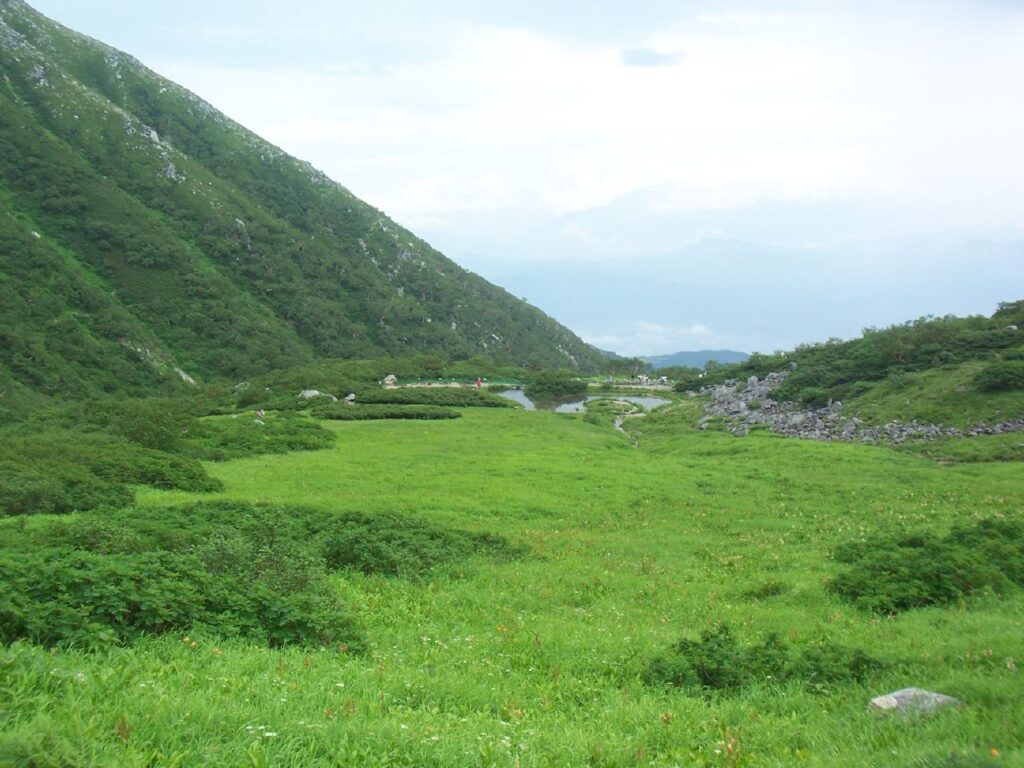
Kengaike Pond, about 20 minutes around the loop, mirroring Mount Hokendake on a still morning.
The 45-Minute Cirque Loop: Step by Step
You do not have to hike to enjoy Senjojiki Cirque. That is the honest truth, and it is why so many people come. A paved loop runs around the lower edge of the cirque, takes 40 to 60 minutes at an easy pace, and gives you full views of Mount Hokendake, the cirque walls, and the seasonal flowers at your feet. Families with young children walk it. Older travellers who would never attempt a peak hike walk it. People in ordinary day clothes walk it. Here is how to do it well.
Step 1: Spend 30 minutes at the station first. Step out of the ropeway, walk onto the terrace, and do nothing in a hurry. You have just climbed 950 metres in seven and a half minutes, and your body needs a short while to catch up. Drink some water, look at the cirque, and let the altitude settle. This is the cheapest insurance you can buy against a headache on the climb later, and it costs you nothing but patience.
Step 2: Visit Komagatake Shrine, then set off around the loop. The shrine stands near the station, and most hikers stop to pay their respects before heading up the trail. From there the loop runs out across the cirque floor on paved stone steps. Wear proper shoes anyway: the path is steep enough in places that flat-soled trainers slip, and there are no handrails. The loop is exposed, with no shade, and the alpine sun at 2,612 metres is much harsher than the temperature suggests — even in August, when the average temperature on the loop is only about 11 to 12 degrees. Bring a hat, bring water, and bring sunscreen.
Step 3: Reach Kengaike Pond, about 20 minutes in. This is the high point of the loop, in every sense. Kengaike is a small pond set into the cirque floor, and on a still morning it mirrors Mount Hokendake so cleanly that it has become the standard postcard shot of the place. On a windy afternoon the surface rumples and the photograph gets harder, which is partly why the early-morning crowd is bigger than the afternoon one. Take your time here. Sit for a few minutes. The flowers are densest on the lower slopes near the pond, and this is where the alpine garden is at its best in late July.
Step 4: Walk the far side and come back past the hotel. The far side of the loop gives you the wide view back across the bowl, with the cirque walls rising on three sides and the drainage running out below you. The acoustics here are strange — voices from a hundred metres away can come back as if they were next to you — which is a small, pleasing oddity of a glacial bowl. The loop brings you back past Hotel Senjojiki, where the wooden terrace is open to day visitors and is the best photo platform on the property. Finish with a coffee at the 2612 Café, and you have had the full cirque experience without climbing a single peak.
Step 5: Know when the loop is closed. From roughly mid-November through April, the loop closes entirely. You can still ride the ropeway up in winter, but the Senjojiki Cirque floor itself is buried under snow, and the walking route does not exist. If you are visiting in winter, come for the snow, the frozen trees and the view from the hotel — not for the loop.
Climbing Mount Kiso-Komagatake from the Cirque
For many visitors, the loop is enough. For others, it is the warm-up. The climb from Senjojiki Cirque to Mount Kiso-Komagatake, at 2,956 metres, is the highest peak in the Central Alps and one of Japan's 100 Famous Mountains — and thanks to the ropeway, it is one of the most accessible high summits in the country. The round trip from Senjojiki Station is about 3.6 to 3.9 kilometres, with roughly 350 to 490 metres of ascent depending on how it is measured, and most fit hikers do it in three to four hours including breaks. That is short by Japanese alpine standards, and it is why this climb shows up on every Japanese-language list of first 3,000-metre-class peaks, even though the summit itself is 44 metres short of 3,000.
Step 1: Climb Hatchozaka, the steep hill out of the bowl. The opening section is a steep climb called Hatchozaka, which means "eight-stretch hill". You leave the cirque floor behind in about 45 minutes of zigzag climbing, passing a big rock and then a set of iron stairs, and you pop out at Norikoshi Jodo, the col at the top of the cirque wall. From here, suddenly, you are on a high ridge looking down on the cirque and across at the entire Northern Alps. It is one of the more dramatic transitions in Japanese hiking: cirque bowl one minute, open ridge the next. Norikoshi Jodo translates roughly as "the pass to the pure land", and standing there, you can see why.
Step 2: Walk the ridge past Hoken Sanso to Mount Naka. From the col, walk past Hoken Sanso, the mountain hut at the pass, and on towards Mount Naka, at 2,925 metres. The ridge to Mount Naka takes about ten minutes, and it is the best stretch of the whole hike for ridge views. From Mount Naka you can see Kiso-Komagatake itself for the first time: a wide, rounded shoulder, far less dramatic than Hokendake but commanding a much bigger horizon. There is a brief descent and re-ascent, with another mountain hut and tent platform at the saddle, before the final 30-minute climb to the summit.
Step 3: Stand on the summit — and look in every direction. The summit is broad, with a small Shinto shrine on the ridge, a triangulation marker, and a wooden post with the elevation. On a clear day you can see Mount Fuji to the south-east, the Yatsugatake range to the east, and the entire Northern Alps spread out to the north. On most days some of those are blocked by cloud, but the view across the Central Alps and back down to the cirque is still excellent. Take the summit photograph, then take a second one looking back down at the bowl you climbed out of. That second photograph is the one that tells the story.
Step 4: Come down slowly, especially on Hatchozaka. The descent is the worst part of the hike, and it is worth saying so plainly. Coming back down Hatchozaka in the afternoon, when you are tired and the rocks have been wet by passing showers, is where most of the slips and rescues on this mountain happen — not on the summit, and not on the ridge. Trekking poles help. So does going down slowly. And so does leaving the summit with enough time in hand to catch the ropeway down at least an hour before the last bus. That last hour is not wasted time. It is the margin that turns a good day into a safe one.
How hard is it, honestly? Japanese hiking sites grade this route as beginner to intermediate, and that is fair, with two caveats. The trail is well maintained and well marked, and the elevation gain is modest — but you start at 2,612 metres, and altitude is real. People who skip the cirque-floor loop and head straight up Hatchozaka often report headaches and dizziness on the first ridge. And the ridge is windy, so pack warm layers and rain gear even in summer. If you have done a mountain like Mount Tsubakuro in the Northern Alps, you will find this climb shorter and gentler — but the altitude at the start is higher, and that changes how your body feels in the first hour.
Mount Hokendake: The Peak to Admire, Not to Rush
Mount Hokendake is the dramatic-looking peak you see from the Senjojiki Cirque loop. At 2,931 metres it is shorter than Kiso-Komagatake, but it looks bigger because it stands closer and rises more steeply, a jagged grey spire of granite that dominates every photograph of the cirque. Climbing it is a different proposition from the loop walk or even the Kiso-Komagatake climb: there are chains, fixed ropes, and a knife-edge ridge where a slip has real consequences, and Japanese-language accident logs treat Hokendake separately from the rest of the range for that reason.
If you are not an experienced climber, do what most people do and skip the actual summit. The path to Kiso-Komagatake bypasses Hokendake by traversing the col below it, and you lose nothing by doing so — the views from Norikoshi Jodo and Mount Naka are, if anything, better, because Hokendake itself is in the frame. If you are experienced and the weather is settled, Hokendake is a serious and rewarding climb, but it needs the right gear, the right conditions, and a realistic sense of your own ability. It is not a place to decide on a whim because the peak looks close.
There is a quieter alternative that most guides do not mention. Mount Inamae, to the east of Hoken Sanso, is a moderate climb of about 3.9 kilometres that takes one and a half to two hours, and because it is off the route to Kiso-Komagatake where most climbers go, you can enjoy a peaceful climb with superb views of the Central Alps and far fewer people. It is a good choice if you want a second, quieter summit after the main one — or if you want a ridge walk without the crowds of the main route.
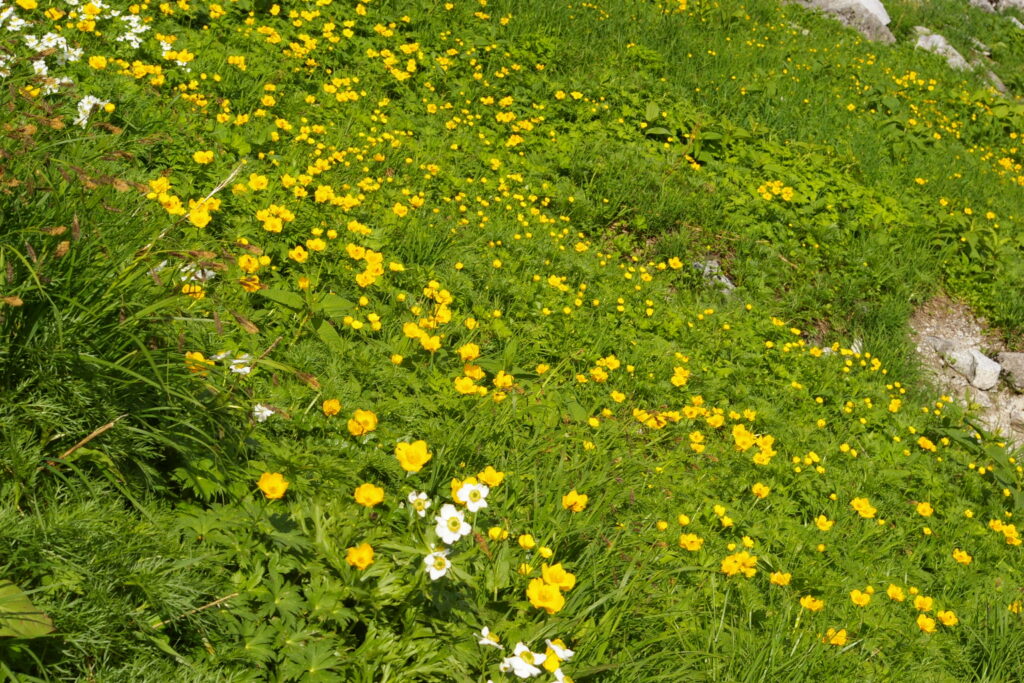
The ridge from Norikoshi Jodo to Mount Naka, looking back down at the cirque bowl below.
Alpine Flowers, Wildlife and the Ptarmigan Comeback
In summer, the Senjojiki Cirque floor turns into a garden. Around 150 species of alpine plant bloom here, with the densest carpet on the lower slopes near Kengaike Pond, and the peak window is shorter than most visitors expect: mid-July to mid-August, with the best of it in the last weekend of July and the first weekend of August. The species list is the operator's official boast, and it is worth learning a few names before you go: kobaikeso, a white globe-flower; koiwakagami, a delicate pink alpine; chinguruma, a low cushion shrub with white flowers and red autumn seedheads; and miyama-kuroyuri, the dark fritillary lily that locals call the black lily. By mid-August the cirque flowers are fading, and the higher slopes near Hoken Sanso are at their best instead — so a late-July visit catches the cirque in full bloom and the ridge at the start of its peak.
That short window is also a conservation story. The cirque is a special conservation area, and the flowers grow slowly at this height. Stay on the path, do not pick them, and do not step off the trail for a photograph. The off-limits zones are there to protect plants and wildlife, and they are enforced. A flower that takes years to grow can be destroyed in a single careless step, and the people who come after you deserve to see the same carpet you did.
Then there is the bird. The raicho, or Japanese rock ptarmigan, is the bird every Japanese hiker hopes to see, and Senjojiki Cirque is now one of the best places in the country to see one — which is remarkable, because for more than fifty years there were none here at all. The Central Alps population went extinct in the 1960s. From 2018, the Ministry of the Environment began a reintroduction programme, taking eggs from the Northern Alps and raising chicks in protected enclosures around Norikoshi Jodo and the Mount Naka ridge. By 2024, some chicks were being raised in the wild on Kiso-Komagatake, and in summer you can see ministry staff in orange vests on the ridge, monitoring the families. They are happy to point out where to look, but they are firm about distance: stay back, do not feed the birds, and do not crouch in the path.
Your chances of seeing one are not high, but they are not zero either. Most hikers who summited in July or August in recent years saw at least one, and the families are easiest to find in the early morning, when the ridge is quiet. In winter the ptarmigan turn pure white and blend into the snow, which is part of the reason almost no one reports seeing them in the cold months. If you do see one, keep your distance and keep your voice down. You are looking at a bird that was brought back from local extinction, one chick at a time, and that is a rarer sight than any summit view. You may also see Japanese serow, the goat-antelope of the high mountains, and stoats in summer — but the ptarmigan is the one that makes people stop and whisper.
Best Time to Visit Senjojiki Cirque: Flowers, Autumn Colour, Snow and Silver Frost
The honest answer to "when should I go?" depends on what you want from the trip, because Senjojiki Cirque is one of the few places in Japan that is genuinely worth visiting in all four seasons — and each season is a different place.
Spring (April to June): the cirque is still under deep snow, with more than two metres covering the open area in April and May, and the whole bowl looks like one huge ski slope. From mid-April to late May, it is one of the few places in Japan where the cirque floor doubles as a backcountry ski slope — a temporary, spring-only operation, with no lifts other than the ropeway and no groomed runs, just open powder and the option to walk up Hatchozaka and ski down. Backcountry tools are required, and most regulars come with a guide. For non-skiers, the April-May window is also when the cirque has its closest equivalent to the Tateyama snow corridor: the ropeway carves a shallow snow tunnel through metres of accumulated snow at the upper station, and you walk out into a bowl that is still half buried. Bring sunglasses regardless of the weather, because the reflected glare is intense, and remember that skiing is possible here even in April or May.
Summer (July to August): the green season, and the best time for hiking. The cirque is carpeted with alpine flowers from mid-July to mid-August, the mountain huts are open, and the days are long. It is also the season of afternoon thunderstorms, and the ridge is exposed, so start early and be off the high ground by the afternoon. Summer weekends are busy, but nothing like autumn.
Autumn (September to November): the busiest and, for many people, the most beautiful season. The reds are nanakamado, the rowan; the yellows are dakekanba, the alpine birch; and the greens are the creeping pine. Together they make a clean three-colour band against the granite. Peak colour usually falls between the third week of September and the first week of October, and here is the detail that catches first-time visitors out: that is about two weeks earlier than Kamikochi or the Tateyama-Kurobe Alpine Route. The Central Alps face south and east, the cirque catches the shorter autumn days harder than the Northern Alps does, and the cold sets in faster. If you are coming on a Northern Alps schedule — Kamikochi typically peaks around 10 to 20 October — you will think you have missed it. You probably have, by a week or two. The colours then descend the mountain through October and into November, so in most years you can enjoy fall colours until late November as they move down from the cirque to the ropeway, the bus route and finally the Komagane highlands. From the end of October to the beginning of December, there is one more thing to look for: the crystal-like silver frost that the operator says appears for only about a month a year.
Winter (December to March): the cirque becomes a world of deep snow, frozen trees and a star-filled sky. The ropeway runs all year round, on a winter timetable with one gondola car running every hour, and the hotel stays open. You cannot walk the loop — it is buried — but you can ride up, step out onto the terrace, and see the bowl as a single white curve under the peaks. Snow starts falling on the peaks from around mid-October at the earliest, and by December mid-winter conditions prevail. Winter here is quiet, cold and beautiful, and it is the season when the place feels most like the glacier that made it.
If you have to pick one month, pick late July for the flowers or the last week of September for the colour. If you have to pick one day, pick a Tuesday. And if you are choosing between this and a Northern Alps trip in the same autumn, remember the two-week gap: do the Central Alps first, then go north.
Hotel Senjojiki and Staying Overnight at 2,612 Metres
Hotel Senjojiki is the only accommodation in Senjojiki Cirque, attached to the upper ropeway station, and at 2,612 metres it is the highest hotel in Japan. It has just sixteen rooms, all of them looking either at the cirque or at the Southern Alps to the east, in simple Japanese-style 10-tatami layouts, some with a private bath. Dinner and breakfast are included, and the dining room has windows on the cirque side. It is small, it is expensive — reported rates were from around ¥28,000 per person on a half-board basis in 2025, with peak rates climbing past ¥35,000 — and it sells out months ahead for autumn weekends and the late-July flower peak. Check the current rates before you decide, because they change with the season.
The reason to stay is sunrise. Morgenrot, the alpine word for dawn alpenglow, is what people come for. The sun rises over the Southern Alps and turns Mount Hokendake's east face deep red for about five minutes. From a regular ropeway day trip you can never see this, because the first cabin up is too late. From the hotel, you walk out onto the wooden terrace at 4:30 a.m. and you are alone with the light. If you want a half-day acclimatisation walk before a Kiso-Komagatake summit attempt, the hotel is worth the cost. Otherwise, the hotels in Komagane town are a fraction of the price and about 90 minutes away by bus and ropeway — a fair trade if the sunrise is not the point of your trip.
If you are not staying overnight, you can still use the hotel's facilities. The 2612 Café inside the building serves curry rice and coffee for around ¥1,200, with windows on the cirque, and the wooden outdoor terrace called SO-RA-TO-KI is open to day visitors and is the best photo platform on the property. The east-facing Lounge 2612 is a paid-by-the-hour private space during the day, and free to overnight guests in the evening, when the stars come out. On a clear winter night, that lounge is one of the best places in the Central Alps to sit and watch the sky.
One more thing about staying up here: the night is part of the experience. The air is thin, the building creaks in the wind, and the morning starts early whether you want it to or not. That is not a complaint. It is the reason the hotel exists, and it is the closest most people will ever come to sleeping inside a glacial cirque.
What to Pack
Packing for the cirque is different from packing for a valley walk, because you arrive at altitude in minutes and the weather can change while you are still on the loop. The list below is for a summer day trip with the Kiso-Komagatake climb; add winter kit and experience if you are going in the snow season.
- Grippy shoes or light hiking boots: the loop is paved stone, but it is steep in places, and Hatchozaka is loose rock and gravel. Flat-soled trainers slip.
- Layers and a rain shell: the temperature at 2,612 metres runs about 10°C lower than in the valley, and the ridge is windy. Even in August, bring a warm layer.
- Sun protection: hat, sunglasses and sunscreen. The UV at altitude is brutal, and there is no shade on the loop.
- Water and food: at least a litre of water for the loop, two litres if you are climbing to the summit, plus snacks or lunch. There is a café at the hotel, but nothing on the ridge.
- Cash and card: the ropeway and hotel take cards, but smaller shops and the bus can be cash-only. Keep some cash handy.
- Trekking poles: not essential for the loop, but very helpful on the descent of Hatchozaka.
- Headlamp: only if you are starting before dawn or staying at the hotel — but cheap insurance on any alpine day.
- A screenshot of your online ticket: the phone signal is weak at the site, so download it before you leave Komagane.
What not to pack: a drone, unless you have checked the current rules — the cirque is a special conservation area, and flying is restricted. And leave the speaker at home. The acoustics of the bowl carry sound further than you think, and everyone else came for the quiet.
Safety, Altitude and Weather
This is the section to read twice, because Senjojiki Cirque's friendliness is also its risk. The ropeway does the climbing for you, which means you arrive at 2,612 metres with no acclimatisation, and the mountain does not care that you arrived by cable car. Altitude sickness is real at this height. Headaches, dizziness and nausea are common in the first hour, especially if you go straight up Hatchozaka. Spend at least 30 minutes on the cirque floor before starting the climb, drink water, and turn back if the headache gets worse rather than better. That is not failure. That is good judgement.
Weather is the second risk. The summit ridge is exposed to wind and fast-changing cloud, and afternoon thunderstorms are the main hazard in July and August. Check a mountain forecast the night before and again at dawn, and be off the high ridge by the afternoon. If the ropeway is suspended for severe weather, do not try to find another way up. There is not one, and that is by design. The same goes for the bus route, which can be closed by rainfall regulations even when the valley looks fine.
There are no bears to worry about here in the way there are on some Northern Alps trails, but there are rules that matter just as much. Stay on the path in the conservation area. Do not feed the ptarmigan or any other wildlife. Do not step off the trail for a photograph in the flower zones. And tell someone your plan — which route, which ropeway down, and when you expect to be back at the bus. The cirque is a managed, visited place, but it is still a high mountain, and the basics still apply.
One last safety note, and it is a practical one. The last ropeway down and the last bus down are not the same thing, and the gap between them is the trap. Plan to be on the ropeway down at least an hour before the last route bus leaves, and check both times on the day — they change with the season, and in the peak autumn weeks the first services start much earlier and the last services stay later than the winter timetable. The operator's timetable page is the source to trust, not a guidebook printed last year.
What Competitor Guides Miss
Most English guides to this place repeat the same three facts — 1967, 950 metres, 2,612 metres — and then stop. That is a shame, because the things they leave out are the things that change your trip. Here are the gaps this guide was written to fill, after reading what is already out there.
First, the ticket. Several guides describe a timed-ticket system for autumn, and some tell you to book a specific ascent slot. There is no timed-ticket system. The online ticket does not guarantee a boarding time, and on very crowded days even online-ticket holders may not be able to board. That is not a small detail. It is the difference between a plan and a hope, and it is why the weekday and the early start matter more than the ticket itself.
Second, the fares. Almost no English guide explains that the ropeway fare is banded by date, from ¥2,290 to ¥3,050 for an adult round trip, or that the English fares page on the operator's site no longer exists — the live fare and timetable pages are in Japanese. If you budget on a single price you found in a blog post, you may be under by a thousand yen or more. Check the fare calendar for your date, and budget for the band your date falls in.
Third, the peaks. Guides routinely call Mount Hokendake the main peak, or show its photograph next to the name Kiso-Komagatake. Hokendake is the photogenic spire. Kiso-Komagatake is the higher, rounder summit hidden behind it, and it is the one on the 100 Famous Mountains list. Knowing which is which matters when you choose a route, because the Hokendake climb is a chained, exposed scramble and the Kiso-Komagatake climb is a well-marked ridge walk.
Fourth, the autumn timing. The colour here peaks about two weeks earlier than Kamikochi and the Northern Alps, in the last week of September and the first week of October. Guides that give you a mid-October date are giving you a Northern Alps date, and by then the cirque has already turned. Go early, or go for the lower slopes instead.
Fifth, the ptarmigan. The reintroduction story — extinct in the 1960s, brought back from 2018, wild-born chicks by 2024 — is barely mentioned in English, and it is the most hopeful wildlife story in the Japan Alps. It is also the reason to keep your distance on the ridge. And sixth, the winter loop: almost no guide says plainly that the loop closes from mid-November to April. If you come in winter, come for the snow and the hotel, not for a walk that does not exist.
Finally, a note on the Central Alps themselves. If you have hiked in the Northern Alps — the Mount Kaikoma area, or Mount Akaishi in the Southern Alps — you will notice the difference at once. The Central Alps are smaller, quieter and more compact, and the cirque is their showpiece. It is not a lesser version of the Northern Alps. It is a different kind of mountain experience: a glacial bowl you can walk into in the morning, and a 2,956-metre summit you can stand on by lunchtime.
A Sample Day Plan
Here is a day that works, based on the timetables and the walking times above. It assumes a summer weekday, a start from Komagane, and a reasonable level of fitness. Adjust it to your own pace, and keep the last hour as margin, not as walking time.
- 07:00 — Leave Komagane Station on the route bus, or Suganodai Bus Center if you drove. Buy or show your online ticket, and screenshot it first.
- 08:00 — Arrive at Shirabidaira. Ride the ropeway up, and spend 30 minutes on the terrace and the cirque floor, acclimatising.
- 08:45 — Walk the loop to Kengaike Pond, then back past the hotel. About an hour, at an easy pace.
- 10:00 — Start the climb to Mount Kiso-Komagatake via Hatchozaka and Norikoshi Jodo.
- 12:00 — Summit, photographs, and lunch on the ridge. Look for ptarmigan on the way up and down, and keep your distance if you see them.
- 13:00 — Descend slowly, with poles, back to Senjojiki Station.
- 15:00 — Coffee at the 2612 Café, a last look at the cirque, and the ropeway down.
- 16:00 — Route bus back to Komagane. If you have time, try the sauce-katsu-don in town — Komagane's local speciality, a deep-fried pork cutlet on rice with a sweet-soy sauce — before the train or bus home.
If you are not climbing the summit, the same day works with a longer, slower loop, a second walk to the far side of the bowl, and a long lunch at the hotel. And if you are staying overnight, do the loop in the afternoon, sleep at the hotel, and climb at dawn, when the ridge is empty and the light is at its best. That is the version of this trip that people remember for years.
Frequently Asked Questions
Can I visit the cirque without hiking?
Yes. The 45-minute loop around the cirque floor needs no hiking experience, no special gear beyond good shoes, and no climbing. You ride the ropeway up, walk the loop, and ride back down. It is one of the most accessible alpine landscapes in Japan.
Is the Kiso-Komagatake climb suitable for beginners?
It is graded beginner to intermediate in Japanese guides, and that is fair with caveats. The trail is well marked and the gain is modest, but you start at 2,612 metres, so altitude sickness is a real risk, and the descent of Hatchozaka is steep and slippery when wet. Spend time on the cirque floor first, carry poles, and turn back if you feel unwell.
Do I need to book the ropeway in advance?
There is no timed-ticket system, and the online ticket does not guarantee a boarding time. It is still worth buying in summer and autumn, because it can save one to two hours, and it can be cancelled free of charge up to the day of use. On very crowded days, reception for day-trip passengers can close early in the morning, so go early regardless of your ticket.
When is the best time to see the alpine flowers?
Mid-July to mid-August, with the best of it in the last weekend of July and the first weekend of August. The peak window is only about three weeks, and it shifts with the rainfall during the rainy season, so check the operator's bloom list before you go.
Can I see Mount Fuji from the cirque?
Yes, on a clear day. Mount Fuji is visible to the south-east from the Kiso-Komagatake summit, and faintly from the ropeway cabin on the way up if the air is dry. It is not guaranteed — cloud blocks it on most days — but when it appears, it is one of the best views in the Central Alps.
Is there anywhere to eat at the top?
Yes. The 2612 Café inside Hotel Senjojiki serves curry rice and coffee, and the hotel dining room serves dinner and breakfast to guests. There is nothing to buy on the ridge itself, so carry water and snacks if you are climbing to the summit.
What if the ropeway is suspended?
Then the trip is off for the day. There is no walk-up to the cirque, and the bus route can also be closed by rainfall regulations. Check the operator's website on the morning you travel, and keep a spare day in your plan if you can. Komagane town, with its distillery, hot springs and sauce-katsu-don, is a good fallback.
Final Thoughts
Senjojiki Cirque is a strange and generous place. It gives you a glacial bowl, a 2,956-metre summit, a hotel at the top of a cable car, and a bird that was brought back from extinction — and it asks for very little in return. A ticket, a bus ride, a walk, and a bit of respect for the altitude and the flowers. That is a fair trade, and it is why the cirque has been loved for so long, first by the people who named it after a thousand tatami mats, and now by everyone who steps out of the cabin and stops, for a moment, just to look.
Go on a weekday if you can. Go early if you cannot. Spend half an hour doing nothing at the top before you start climbing. Learn the names of three flowers and one bird before you go, and you will see the place differently when you are standing in it. And when you come back down — whether you climbed the summit or only walked the loop — take the long way home through Komagane, and think about what you have just seen: a bowl carved by ice 20,000 years ago, still holding its shape, still full of flowers, and still, on a clear morning, reflecting a mountain in a pond. There are not many places in Japan where you can say that. This is one of them, and it is worth the journey.
If this guide helped you plan, the next step is a simple one: check the fare calendar for your date, buy the online ticket, and confirm the timetable the week you travel. The mountain will do the rest. And if you want to keep exploring the Japan Alps, the guides to Mount Kumotori, Mount Ryugatake and Houou Sanzan follow the same honest, research-based approach — practical information first, and no claim the author cannot stand behind. As the About Us page puts it: "I'm an enthusiast, not an expert. I share what I learn about Japan's outdoors through careful research, and I try to be honest about what I know and what I don't." That is the promise of this site, and it is the promise of this guide.
Photo credits
- Photo: Mount Hoken by Alpsdake, CC BY-SA 3.0 (cropped), via Wikimedia Commons
- Photo: Mount Hoken & Senjojiki Cirque by sota from Tokyo, Japan, CC BY-SA 2.0, via Wikimedia Commons
- Photo: Senjōjiki Cirque 03 by Hajime NAKANO from Tokyo, Japan, CC BY 2.0, via Wikimedia Commons
- Photo: Alpine Flowers in Senjojiki Cirque Japan by User:Utudanuki, CC BY-SA 3.0, via Wikimedia Commons
