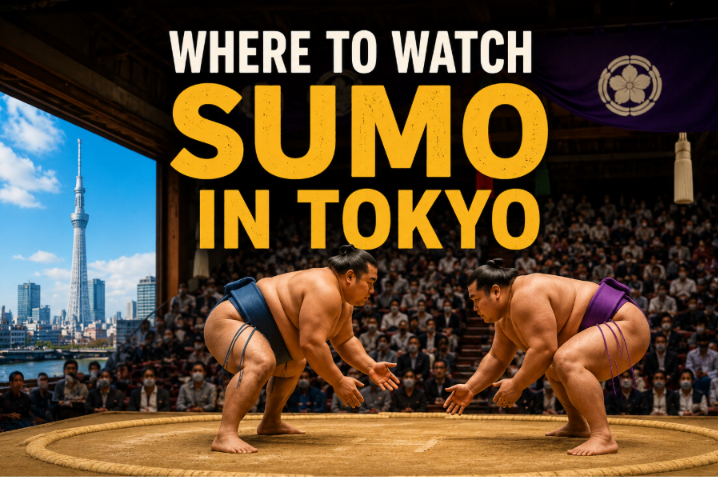
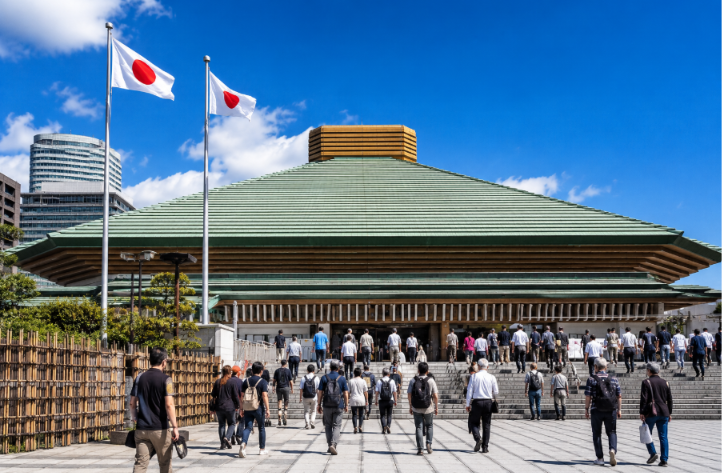
The best place to watch sumo in Tokyo is the Ryogoku Kokugikan, the sumo arena in Sumida Ward. It hosts three of the six Grand Sumo tournaments each year, in January, May and September, and each one runs for 15 days. The hard part is not getting there but getting a ticket: the best seats sell out fast, and most tickets are sold before overseas visitors can see them.
This guide covers the 2026 dates, what tickets cost, where to buy them and what to do if you miss out. Dates and prices are taken from the sources listed at the end, with the date we last checked them.
Table of Contents
- Tokyo Sumo Tournaments in 2026
- Sumo Ticket Prices and How to Buy Them
- Types of Sumo Seats
- What a Tournament Day Is Like
- How a Sumo Bout Works: A Quick Guide for First-Timers
- Etiquette and What to Bring
- Around Ryogoku: Museums, Chanko and Sumo Sights
- Morning Practice at Sumo Stables
- Other Ways to Experience Sumo
- Two Sample Plans Around Ryogoku
- Sumo in Tokyo FAQ
- Sources and Last Check
Tokyo Sumo Tournaments in 2026
| Tournament | 2026 dates | Tickets on sale from |
|---|---|---|
| Hatsu Basho (January) | January 11–25 | December 6, 2025 |
| Natsu Basho (May) | May 10–24 | April 4, 2026 |
| Aki Basho (September) | September 13–27 | August 8, 2026 |
All three are at Ryogoku Kokugikan, a short walk from Ryogoku Station on the JR Sobu Line and the Toei Oedo Line. The 2026 Tokyo tournaments are now over, The next Tokyo tournament is the January 2027 Hatsu Basho, January 10–24, with tickets on sale from December 5, 2026. The Japan Sumo Association announces its dates and sale days, so check its site before you plan a trip around it.
Tokyo Sumo Dates for 2027
The Japan Sumo Association has published its 2027 schedule. Advance tickets for each tournament go on sale at 10:00 a.m. Japan time on the dates below, and the ranking sheet (banzuke) is released two to three weeks before the first day, which is after tickets are already on sale. The best days often sell out quickly, so do not wait for the rankings.
| Tokyo tournament | 2027 dates | Tickets on sale from | Rankings announced |
|---|---|---|---|
| Hatsu Basho (January) | January 10–24 | December 5, 2026 | December 21, 2026 |
| Natsu Basho (May) | May 9–23 | April 10, 2027 | April 26, 2027 |
| Aki Basho (September) | September 12–26 | August 7, 2027 | August 30, 2027 |
Sumo in Osaka, Nagoya and Fukuoka
Tokyo hosts three of the six yearly tournaments. The other three are in Osaka, Nagoya and Fukuoka, which is useful if your trip does not match a Tokyo date. If you are in Japan this autumn, the next tournament anywhere is in Fukuoka in November.
| Tournament | Dates | Venue | Tickets on sale from |
|---|---|---|---|
| Kyushu Basho (Fukuoka) | November 8–22, 2026 | Fukuoka Kokusai Center | September 19, 2026 (already on sale) |
| Haru Basho (Osaka) | March 14–28, 2027 | EDION Arena Osaka | February 6, 2027 |
| Nagoya Basho | July 11–25, 2027 | IG Arena, Nagoya | May 15, 2027 |
| Kyushu Basho (Fukuoka) | November 14–28, 2027 | Fukuoka Kokusai Center | September 18, 2027 |
Fukuoka can also be cheaper. For the November 2026 tournament, the Association’s pricing lists a weekday chair seat from ¥2,000, which one guide calls the cheapest general seat at any current tournament.
Sumo Ticket Prices and How to Buy Them
Official tickets are sold through the Japan Sumo Association’s ticket site, Ticket Oosumo. Advance sales open roughly a month before each tournament. Published prices at Ryogoku range from about ¥2,200–¥2,500 for the cheapest seats up to ¥20,000 or more for ringside seats. One guide that quotes the Association’s own pricing page for September 2026 lists ¥2,500 for an adult and ¥500 for a child in the cheapest seats. Prices are set for each tournament, so check the page for the one you plan to see.
Ways to get a ticket
- The official site: the cheapest and most direct route, but demand is high and the system can be hard to use from overseas
- Resellers and tour packages: sites such as Klook, Voyagin and Rakuten sell English e-tickets, usually at higher prices than the official site
- Same-day tickets: a few seats are sometimes available at the venue on the day. Do not plan around this, because popular tournaments sell out
Most seats are pre-sold through the Association’s fan clubs, which are not open to most overseas visitors, and some guides report the September 2026 tournament selling out well in advance. If you want to go, set a reminder for the sale day.
Official Ticket Prices by Seat (September 2026 Tournament)
These are the Association’s published prices for the September 2026 Tokyo tournament, which include tax. Prices are set for each tournament, so check the page for the one you plan to attend.
| Seat | Weekday | Weekend / holiday | Notes |
|---|---|---|---|
| Tamari (ringside) | ¥20,000 | ¥20,000 | Per person. Closest seats on the ground floor. Sold on the Japanese ticket site |
| Masu S (box for four) | ¥56,000 per box (¥14,000 per person) | ¥60,000 per box (¥15,000 per person) | Floor seating. Sold as a whole box, so a pair still pays for four |
| Chair S | ¥9,000 | ¥9,500 | Second floor, closest chair grade |
| Chair A | ¥8,000 | ¥8,500 | |
| Chair B | ¥5,000 | ¥5,500 | |
| Chair C | ¥3,500 | ¥4,000 | Lowest-cost chair grade listed on the English ticket page |
| Chair D | ¥2,500 adult, ¥500 child | Upper tier. The cheapest official seat | |
Buying on the Official English Site
- Be ready at 10:00 a.m. Japan time on the on-sale day, and create your account in advance so you are not registering when the clock starts.
- Expect a service fee. A ticketing guide that checked the English site in July 2026 reports a ¥2,000 fee per ticket, on top of the seat price.
- Tickets are printed at a 7-Eleven in Japan. The same guide notes that tickets bought through the English page must be collected this way, so plan to do it after you arrive.
- Some seats are not on the English page. Premium seats can appear only on the Japanese Ticket Oosumo site.
- If your date is sold out, try another date or another seat grade on the official site before you pay more elsewhere. Weekdays are easier than weekends and the final days.
- Avoid individual resellers. One ticketing guide notes that Japan’s anti-scalping law restricts unauthorised resale of designated tickets. Use the official site, an official resale option, or a licensed tour package.
How Fast Tickets Sell Out
Do not assume you can decide later. A Tokyo Cheapo writer describing the January 2026 tournament says the ticket system crashed at 10 a.m. on the on-sale day and that all tickets had gone by the time it came back three hours later. They ended up buying a guided package with a second-floor B-class chair seat for ¥19,000. If you want a specific day, set a reminder for the sale date.
Same-Day Tickets
A limited number of unreserved seats go on sale at the Kokugikan box office on the day. Published details vary: an older Kokugikan guide says sales start around 7:45 a.m., about 100 tickets are available, payment is in cash, everyone in your party must be present, and anyone over age 3 needs a seat. A newer guide says around 400 seats at roughly ¥2,200 each. Treat the number as uncertain, arrive early, and have a backup plan, especially on weekends and the last days.
Types of Sumo Seats

- Box seats: floor seating on cushions in a box for several people. They can be tiring for visitors who are not used to sitting on the floor
- Chair seats: ordinary seats on the upper levels, usually the best-value choice for first-timers
- Ringside seats: the closest and most expensive. They are rarely available to overseas buyers
Which Seat Should You Choose?
- First-timer, want comfort: a chair seat on the second floor. They are easier to get and you sit in an ordinary seat. Binoculars help in the upper rows.
- Group of four who want the classic experience: a box seat (masu). You sit on a cushion on a tatami floor, which is a tight fit, but you can eat and drink at your seat.
- Pair: think twice about a box. You pay for all four places, so two chair seats are usually better value.
- Closest possible view: tamari, but expect rules. Eating, drinking and photography are not allowed there during bouts, and wrestlers sometimes fall into the front rows.
- Tight budget: the cheapest chair grades, a same-day ticket, or a weekday ticket at the Fukuoka tournament.
At the Tokyo arena the ground floor holds the tamari and box seats, and the chair seats are on the second floor.
What a Tournament Day Is Like
- Doors typically open around 8:45 a.m., and the arena fills up as the day goes on
- Lower-ranked wrestlers fight early in the day, and the best-known wrestlers fight in the late afternoon
- Announcements are in Japanese, but an English commentary radio can be rented in the hall for about ¥100 plus a deposit, according to one guide. Check at the venue.
- The Kokugikan also has a sumo museum, so check its opening times if you want to visit
A Typical Tournament Day, Hour by Hour
Times are approximate and vary slightly from day to day.
| Time | What happens |
|---|---|
| About 8:00–8:45 a.m. | Doors open. Guides differ by up to 45 minutes, so check the day’s schedule. |
| Morning | Lower-division bouts in a quiet arena. Good for photos and for watching younger wrestlers. |
| About 2:00–3:30 p.m. | The second division (juryo) fights and the arena fills. |
| Around 3:40 p.m. | Top-division (makuuchi) wrestlers enter the ring in decorated aprons in the ring-entering ceremony (dohyo-iri). |
| Late afternoon | Top-division bouts build toward the highest-ranked wrestlers. A yokozuna, if active, has his own ceremony. |
| Just before 6:00 p.m. | The last bout, then the bow-twirling ceremony (yumitori-shiki) closes the day. |
- One ticket covers the whole day. Two guides say you may leave and re-enter once, which is handy for a meal outside. Confirm at the gate.
- English commentary: one guide reports a rental radio for about ¥100 plus a deposit, with commentary running roughly 4–6 p.m.
- Food: there are food outlets inside, the arena is known for bento boxes and yakitori, and a food complex called Edo Noren sits between the Kokugikan and JR Ryogoku Station.
- If you only want the headline bouts, arrive early afternoon. For a quiet arena and easy photos, come in the morning.

How a Sumo Bout Works: A Quick Guide for First-Timers
A top-division bout can be over in seconds, and the ritual around it is half the show. Knowing a few basics makes the day much easier to follow.
- How to win: two wrestlers (rikishi) face off in a clay ring called the dohyo, about 4.55 metres across. A wrestler loses if he steps outside the ring or touches the clay with anything other than the soles of his feet.
- The ritual: before a bout, wrestlers rinse their mouths with “power water”, throw salt to purify the ring, and stomp their legs (shiko). They then crouch, stare each other down and often retreat to their corners before the actual charge (tachiai).
- Rankings: there are six divisions. The top is makuuchi and the second is juryo. Within makuuchi the ranks rise from maegashira through komusubi, sekiwake and ozeki to yokozuna, the grand champion. The ranking sheet (banzuke) is published before each tournament.
- The tournament: each wrestler in the top two divisions fights once a day for 15 days. The best record in the top division wins the Emperor’s Cup, and the final days are often the most dramatic because the title is usually decided then.
- Make it personal: pick two or three wrestlers to follow. Watching the NHK highlights the night before makes the bouts easier to care about.
Etiquette and What to Bring
- Cash. Bring cash for the same-day box office, souvenirs and the radio rental.
- Comfortable clothes. In box seats you sit on the floor for hours, so wear something you can fold your legs in.
- Binoculars for the upper chair seats.
- Food and drink are fine in box and chair seats, but not in the tamari seats during bouts.
- Do not throw your seat cushion. You may see locals do it after a big upset, but visitors should not copy it.
- Children: anyone over 3 needs their own seat for same-day tickets, and the cheapest official seat has a ¥500 child price.
- January weather: the January tournament falls in the coldest weeks of the year. See our guide to when it gets cold in Japan for what to wear.
Around Ryogoku: Museums, Chanko and Sumo Sights
Ryogoku is worth half a day even when no tournament is on.
- Sumo Museum: inside the Kokugikan and free to enter. One guide says access may be limited to ticket-holders during tournaments, so check its opening times.
- Edo-Tokyo Museum: right next to the Kokugikan. It reopened on March 31, 2026 after about four years of renovation and covers roughly 400 years of Tokyo’s history from the Edo period to today. It is a 3-minute walk from the West Exit of JR Ryogoku Station and a 1-minute walk from exit A3 or A4 of Ryogoku Station on the Toei Oedo Line.
- Sumida Hokusai Museum: about a 5-minute walk from the Edo-Tokyo Museum.
- Chanko-nabe: the hotpot sumo wrestlers eat. One local guide names Chanko Tomoegata, which it says was founded by a former wrestler in 1976, and Kappo Yoshiba, set in a former sumo stable with the training ring preserved. Call ahead on tournament days and check current menus and prices.
Morning Practice at Sumo Stables
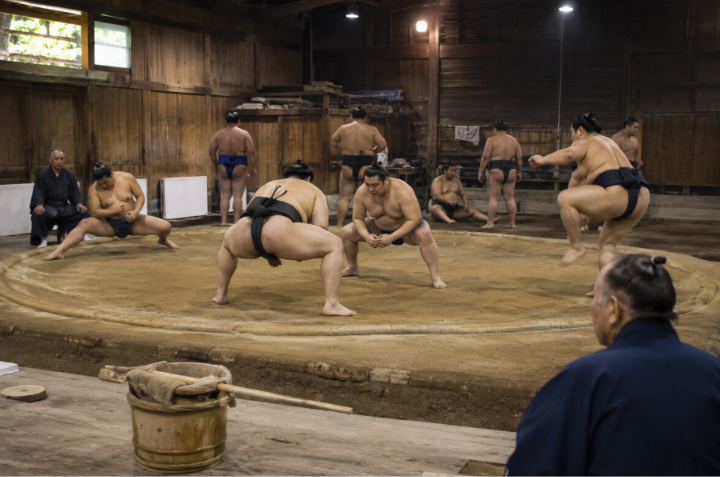
Wrestlers train in the morning at their stables, many of them in the Ryogoku area. Visiting is possible at some stables, but most need advance arrangements and have strict rules about quiet and behaviour. Use an official or licensed arrangement rather than just turning up, and follow the stable’s instructions.
What Happens at Practice
Morning practice (asa-geiko) is not a show. Lower-ranked wrestlers usually start, and the higher-ranked ones join later, so the intensity rises as the session goes on. A visitor who joined a tour describes bouts, repeated practice matches and a stretching routine to finish, with sessions lasting over an hour.
Rules for Visitors
- Sit quietly on the floor and do not leave in the middle of practice. One tour operator notes that you cannot use the toilet during the session.
- No flash photography, and photos with wrestlers are only allowed after practice and at the stable’s discretion.
- One operator bans sunglasses and hats inside the stable.
- Do not enter a stable by yourself. Tour operators ask you to wait outside for the guide.
Timing and Booking
- There are around 45 stables, mostly in Ryogoku and the nearby Asakusa area. Practice runs from early morning for a few hours, and guided visits usually last one to two hours.
- One guide puts typical tour prices at roughly US$70–120 per person for a small group.
- Stable details are often confirmed only about a week before, so book flexibly.
- Stables travel to the host city for the Osaka, Nagoya and Fukuoka tournaments, and one operator notes stables are closed to visitors then. Tokyo stable visits are therefore most likely in the months around the Tokyo tournaments.
- During the Tokyo tournament fortnights, one operator says practice is much shorter, around 30–40 minutes.
Other Ways to Experience Sumo
- Regional tour events (jungyo): between tournaments, wrestlers tour Japan for exhibition days that are more relaxed and family-friendly. Dates are listed on the Japan Sumo Association’s site.
- Retirement ceremonies (danpatsu-shiki): a popular wrestler’s retirement is held at the Kokugikan and tickets are sold separately.
- Sumo experience shows: some Tokyo venues run tourist-friendly demonstrations by former wrestlers, often with a chanko meal. They are not the real thing, but they are available year-round.
- Watch on TV: NHK broadcasts the top division daily during each tournament, and the Association posts highlights online.
- Another city: see the Osaka, Nagoya and Fukuoka dates above.
Two Sample Plans Around Ryogoku
Plan A: A tournament day
- Late morning: arrive in Ryogoku and eat at Edo Noren or pick up a bento.
- Around 2 p.m.: take your seat for the second-division bouts and the arena filling up.
- Mid-afternoon to about 6 p.m.: watch the top-division ceremony and the final bouts.
- Evening: chanko-nabe nearby, calling ahead to reserve.
Plan B: A day with no tickets
- Morning: a guided stable visit, if one is running.
- Lunch: chanko-nabe.
- Afternoon: the Edo-Tokyo Museum, then the Sumo Museum if it is open.
- Evening: watch the NHK highlights to follow the tournament, if one is on.
Sumo in Tokyo FAQ
When are the Tokyo tournaments?
Every January, May and September. In 2026 they ran January 11–25, May 10–24 and September 13–27.
How much does a sumo ticket cost?
From about ¥2,200–¥2,500 for the cheapest seats up to ¥20,000 or more for ringside. Resellers charge more.
Where do I go?
Ryogoku Kokugikan, which is next to Ryogoku Station.
What if I cannot get a ticket?
Try a reseller or a guided package, check for same-day seats, or visit the sumo museum and the Ryogoku area instead.
When is the next sumo tournament?
The next tournament anywhere in Japan is in Fukuoka, November 8–22, 2026. The next in Tokyo is the Hatsu Basho on January 10–24, 2027.
When do sumo tickets go on sale?
Roughly a month before each tournament, at 10:00 a.m. Japan time. For January 2027 it is December 5, 2026.
Which seat is best for a first-timer?
A chair seat on the second floor is comfortable and easier to get. A box seat is the classic choice for a group of four.
How much is a chair seat?
For the September 2026 tournament, chair seats ranged from ¥3,500 (grade C, weekday) to ¥9,500 (grade S, weekend), with a cheaper grade D at ¥2,500 for adults.
How long should I stay?
Your ticket covers the whole day. The headline action runs from mid-afternoon to about 6 p.m., so a half-day is enough if you are short of time.
Can I leave and come back?
Two guides say you may leave and re-enter once on the same day. Confirm at the gate.
Can I eat and drink?
Yes in box and chair seats. Not in the tamari seats during bouts.
Is sumo suitable for children?
Yes. There is a ¥500 child price on the cheapest seat, and anyone over age 3 needs their own seat for same-day tickets. Plan for a long day and bring something to eat.
Can I watch sumo for free?
You can watch the top division on NHK during tournaments, and the Association posts highlights online. The Sumo Museum inside the Kokugikan is free but may be restricted to ticket-holders during tournaments.
Do I need to speak Japanese to buy tickets?
No. There is an official English ticket site, though it adds a service fee and tickets are collected at a 7-Eleven in Japan.
Sources and Last Check
We compiled this guide from published schedules, fan guides and the Association’s pricing, not from our own visit. We last checked these sources on October 9, 2026. Dates, prices and sale days change, so confirm them with the Japan Sumo Association before you book.
- Tokyo Tourism: How to watch sumo in Tokyo, 2026 dates and tickets
- Watabi: Sumo tickets 2026–27, official prices
- Self Guide Japan: Grand Sumo Tokyo September 2026
- Japan Travel Planning: 2026 sumo tournament schedule
- Tanaka Tokyo Tours: Sumo tournament and exhibitions in Tokyo
- Nomado Travel: Tokyo sumo guide
- Maezumou: 2026–27 tournament schedule and on-sale dates
- Self Guide Japan: Grand Sumo January 2027
- Real Japan Guide: Tokyo sumo September 2026, tickets and fees
- Japanode: how to watch sumo in Japan
- Tickets in Japan: Tokyo sumo ticket prices and seating
- Tokyo Tourism: sumo wrestling in Tokyo
- Japan Travel: guide to sumo at the Kokugikan
- Tokyo Cheapo: sumo tournament practical guide
- Tokyo Metropolitan Government: Edo-Tokyo Museum reopening
- Tokyo Weekender: Edo-Tokyo Museum reopening
- Japan Wonder Travel: a sumo morning practice experience
- Headout: Tokyo sumo morning practice tour rules
