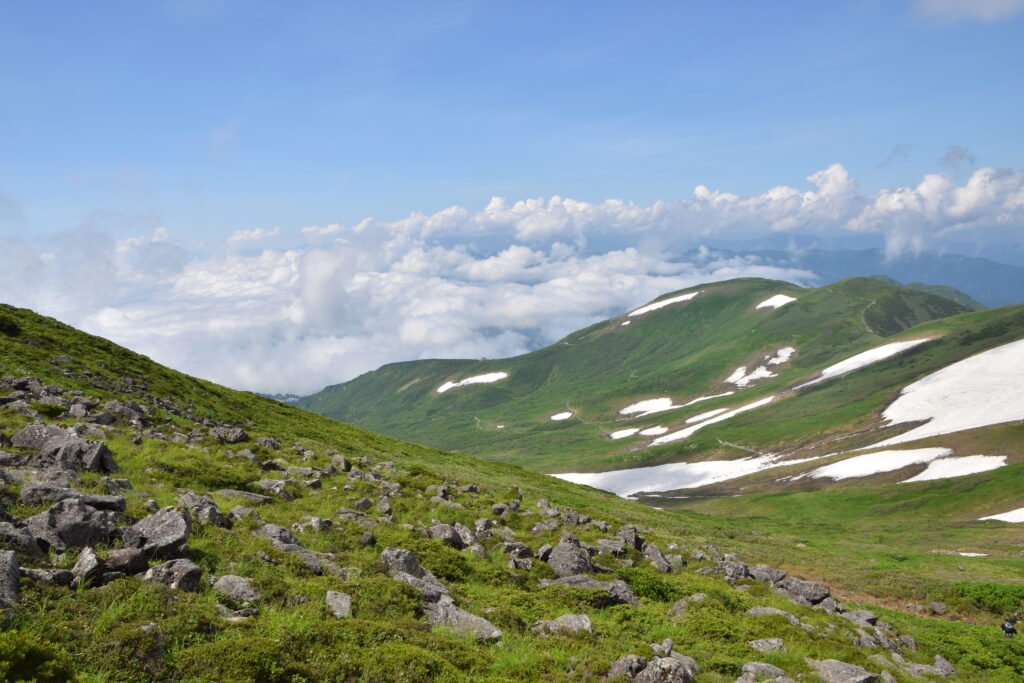
Mount Gassan — spelled with one S, despite what a surprising number of websites (including the old version of this page) will tell you — is the highest of the three sacred Dewa Sanzan peaks in Yamagata Prefecture, and one of Japan’s 100 Famous Mountains. At 1,984 meters, it’s a serious, rocky, weather-beaten summit that has drawn pilgrims for over a thousand years and hikers for far longer than Japan’s mountain tourism has existed.
What makes Gassan unusual is its split personality. In summer it’s a classic alpine hike: a 2.5-hour climb from the 8th station trailhead over boulder fields to a summit shrine. But from April into mid-summer, those same slopes host one of the strangest sights in Japanese skiing — lift-served summer skiing, with skiers carving turns in t-shirts while the valleys below are already humid. Few mountains in Japan pack that much contrast into one peak.
This guide covers the hiking route from the Hachigome trailhead, how to reach it by public transport from Tsuruoka, what the climb is actually like, and the safety realities of a mountain famous for sudden weather changes.
Table of Contents
Quick facts
| Mountain | Mount Gassan, 1,984 m — highest of the Dewa Sanzan, one of Japan’s 100 Famous Mountains |
| Location | Yamagata Prefecture, Tohoku |
| Trailhead | Gassan Hachigome (8th station), reached by bus from JR Tsuruoka Station |
| Difficulty | Moderate — 2.5 hours up from the 8th station, rocky with sections where you’ll use your hands |
| Time needed | 5–6 hours round trip from the trailhead, plus bus travel |
| Hiking season | July to early October (snow lingers into early summer) |
| Don’t miss | Summer skiing (April–mid/late July); Gassan Shrine on the summit |
Getting there
Reaching Tsuruoka
Every Gassan trip funnels through Tsuruoka, the nearest major city and rail hub. From Tokyo, the standard route is by Shinkansen and limited express via Niigata, or by overnight highway bus — check current timetables and book ahead in hiking season, as the best connections are limited. Tsuruoka is a proper regional city with hotels, restaurants, and gear shops, so it’s also where you stock up on anything you forgot.
Tsuruoka Station to the trailhead
From JR Tsuruoka Station, take the Shonai Kotsu bus bound for the mountain. The one-way fare to Gassan Hachigome (the 8th station trailhead) is ¥2,140. The bus climbs from the city into the mountains and drops you at the trailhead area, where the hiking route begins.
Buses on this route are not frequent — this is a mountain bus, not a city service. Check the timetable before you travel, note the departure time of the last bus back down, and plan your hike to finish with a comfortable margin. Missing the last bus from the 8th station is the classic Gassan logistical failure, and it’s entirely avoidable.
The route: 8th station to the summit
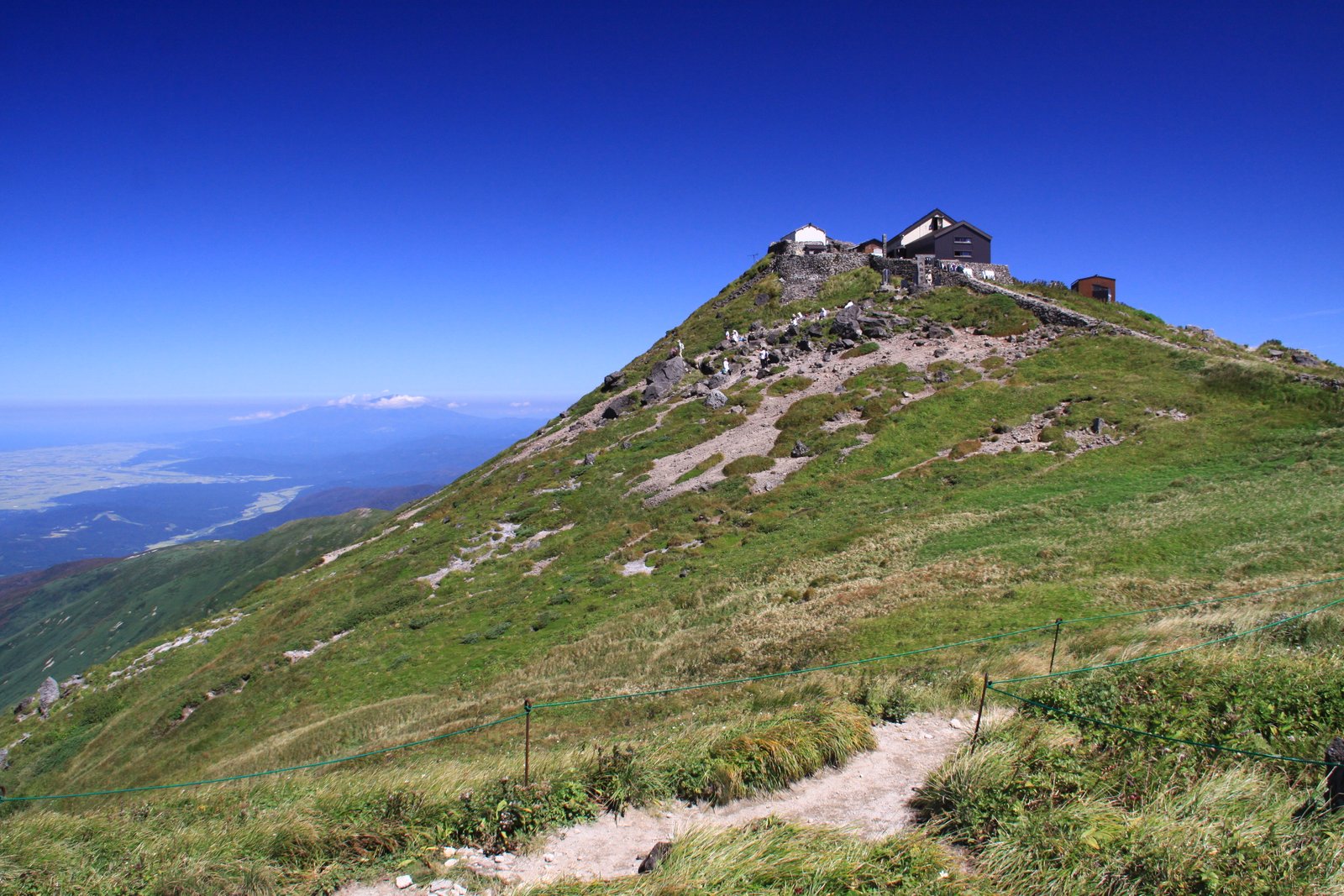
The standard hiking route starts at Gassan Hachigome — the 8th station — and climbs to the summit in about 2.5 hours. (Note the name: it’s Hachigome, “8th station.” Older write-ups sometimes render it as “Hachigame,” which is simply wrong.)
The trail is rocky from early on. This isn’t a smooth forest path — it’s boulder fields, uneven stone steps, and exposed mountainside, with sections where you’ll want your hands free for balance and scrambling. Gloves are genuinely useful here, not just a packing-list filler. The route is well marked in season, but in fog the cairns and markers are what you’ve got, so keep them in sight.
As you climb, the vegetation thins and the views open: across the Shonai plain to the Sea of Japan on clear days, and over to neighboring peaks of the Dewa Sanzan. The final push to the summit is the rockiest part, and it can feel longer than it looks — pace yourself.
The summit: Gassan Shrine
The summit of Gassan is occupied by Gassan Shrine, the highest of the three Dewa Sanzan shrines and the spiritual reason the mountain has been climbed for centuries. Pilgrims in white robes still make the ascent in summer, and the atmosphere at the top — prayer, bells, the smell of incense against the wind — is unlike any ordinary mountain summit in Japan.
Entering the shrine precinct at the summit costs ¥500. Bring cash; there’s no card terminal on top of a sacred mountain. The shrine is only staffed and open during the summer season, roughly matching the hiking season.
Most hikers descend by the same route, making the round trip from the 8th station about 5–6 hours including time at the summit. Allow longer if you’re photographing, shrine-visiting, or simply moving slowly over the rocks — and keep one eye on the bus timetable for the ride back to Tsuruoka.
How hard is it?
Moderate, with honest caveats. The 2.5-hour ascent from the 8th station is within reach of any reasonably fit hiker, and there’s no technical climbing. But the rockiness is real — this is ankle-turning terrain, the hands-needed sections demand some confidence, and the mountain’s weather is famously volatile. A fit beginner in good conditions will be fine; anyone in poor conditions, or in worn-out sneakers, will not have a good day.
The bigger challenge is logistical: limited buses, a long day from Tsuruoka, and weather that can close in fast. Treat Gassan with the respect a 2,000-meter Tohoku peak deserves and it’s a superb day out.
When to go
Hiking season: July to early October
The hiking season runs roughly from July to early October. Snow lingers on the upper mountain well into early summer — which is exactly what makes the next section possible — and by October the first snows of autumn can arrive. July through September is the reliable window, with August the busiest.
Summer skiing: April to mid/late July
Gassan’s famous quirk: the ski season runs from April into mid or late July, on the deep snowpack left by winter. Skiers ride up and carve spring snow in warm sunshine while the rest of Japan is heading for the beach. If you visit in early summer, you’ll share the mountain with skiers — an only-in-Japan experience and well worth timing a trip around if the dates work.
Autumn
By late September into early October, the alpine slopes turn with autumn color — a short, brilliant season before the mountain closes down for winter. The colors against the dark volcanic rock are striking, but this is also when weather windows get shorter and colder. Go prepared, and go early in the day.
What to pack
- Full rain gear — non-negotiable. Jacket and pants. Gassan is notorious for sudden weather changes, and getting soaked at 1,900 meters with the bus hours away is a genuinely bad situation.
- Warm layers — even in August, the summit can be cold and windy. A fleece or insulated mid-layer lives in the pack.
- Sturdy hiking boots with ankle support — the boulder fields punish soft shoes. This is not a sneakers mountain.
- Gloves — for the hands-needed rocky sections.
- 1.5–2 liters of water and food — there is nothing to buy on the trail.
- Cash — ¥500 for the summit shrine, ¥2,140 each way for the bus, plus a buffer.
- Headlamp — in case the descent runs long. Days are short in October.
- Sun protection — the upper mountain is fully exposed.
Where to stay
Tsuruoka is the practical base: hotels near the station, restaurants for a post-hike meal, and the morning bus to the trailhead. Staying in Tsuruoka the night before also gives you a buffer to check the weather and the bus timetable without rushing. The Dewa Sanzan area also has traditional pilgrim lodgings (shukubo) around the other two sacred peaks, Mt. Haguro and Mt. Yudono — worth considering if you’re making a multi-day pilgrimage of all three.
Our tips
- Memorize the last bus down before you start climbing. The Shonai Kotsu bus from Hachigome is infrequent, and the hike plus summit time can easily eat 6 hours. Work backwards from the bus, not forwards from your ambition.
- Start early. Afternoon cloud and rain build quickly on Gassan. An early start means the rockiest sections in the best light and the best weather of the day.
- Bring the rain gear even when the sky is blue. We mean it — this mountain’s weather turns faster than almost anywhere else in Honshu. The gear list above isn’t aspirational.
- Carry cash for the shrine. The ¥500 summit shrine fee is cash only, and you’ll regret not having it when you’re standing at the top.
- Consider the summer-ski season. Visiting in June or early July lets you watch (or join) skiers on the upper slopes — then come back in August or September for the pure hiking experience.
- Spell it Gassan. One S. Your search results and your credibility will thank you.
Frequently asked questions
Is it “Gassan” or “Gassen”?
Gassan — one S. “Gassen” is a misspelling that propagated across English-language blogs (including the previous version of this page, which we’ve now corrected). The mountain is 月山, the highest of the Dewa Sanzan.
Can you really ski on Gassan in summer?
Yes. Thanks to enormous winter snowfall, the ski season on Gassan’s upper slopes runs from April into mid or late July. It’s lift-served spring skiing in warm weather — one of the most unusual ski experiences in Japan.
Do I have to pay at the summit shrine?
Entering the Gassan Shrine precinct on the summit costs ¥500, cash only. The shrine operates during the summer season. Even if you don’t enter, the summit area and its views are the reward for the climb.
How difficult is the climb, honestly?
About 2.5 hours up from the 8th station over rocky, uneven terrain with sections where you’ll use your hands. Fit hikers will find it moderate; it’s not technical, but it’s not a walk in the park either. The weather is the real variable — in rain and fog it becomes a serious undertaking.
What happens if the weather turns bad mid-hike?
Turn back. Gassan’s weather changes fast, the rocks get slippery, and there’s no shelter on the upper mountain. This is why full rain gear is mandatory and why you check the forecast before boarding the bus in Tsuruoka.
Can I do Mount Gassan without a car?
Yes — the Shonai Kotsu bus from JR Tsuruoka Station to Gassan Hachigome (¥2,140 one way) is the standard public-transport access. Just build your whole day around the bus timetable, because services are limited.
Final thoughts
Mount Gassan is the kind of mountain that reminds you why the Dewa Sanzan have drawn pilgrims for a millennium: a rocky, windswept summit with a shrine on top, reached by honest effort and rewarded with views to the Sea of Japan. Climb it in summer for the full experience, come in early summer for the surreal sight of skiers, and always — always — bring the rain gear. For more single-day mountain ideas across the country, see our best one-day hikes in Japan roundup.
