
Most guides suggest arriving with about ¥10,000 to ¥50,000 in cash, then topping up from a 7-Eleven ATM as you go. Japan takes cards in most big-city shops, hotels and chains, but cash still matters for small restaurants, markets, rural areas and mountain trips.
This guide covers how much to carry, how to get yen with a foreign card, and the places where cash is the only option. Figures come from the 2026 guides listed at the end. Exchange rates move daily, so we do not quote one: check the current rate before you go.
Table of Contents
Is Japan Still a Cash Country in 2026?
Less than before, but still more than most visitors expect. Watabi cites the Ministry of Economy, Trade and Industry (METI) as reporting that Japan’s cashless payment ratio reached 58% in 2025, mostly through credit cards, followed by QR codes, electronic money and debit cards. The government’s long-term goal is 80%, with an interim target of 65% by 2030. Cities are therefore largely card-friendly, and rural areas are not.
Cash resilience clusters in a few places that guides repeatedly name:
- Shrine and temple offerings, charms and goshuin stamps
- Owner-run small shops and diners, and the ticket machines at some ramen shops
- Traditional markets and festival stalls
- Some local buses and taxis in regional areas
- Rural guesthouses and traditional ryokan
How Much Cash to Carry
| Trip style | Rough guidance | Source note |
|---|---|---|
| Starting cash on arrival | ¥10,000–¥20,000, or ¥30,000–¥50,000 to be comfortable | Withdraw from a 7-Eleven ATM after landing instead of exchanging at the airport |
| Cash in your wallet each day | ¥20,000–¥30,000 | One 2026 money guide’s daily recommendation |
| Budget traveller, 14 days | About ¥70,000 in cash | One 2026 guide’s estimate |
| Mid-range traveller, 14 days | About ¥240,000 total spending, much of it on card | Total spending, not all cash |
| Comfortable traveller, 14 days | Up to ¥500,000 total spending | Total spending, not all cash |
Guides vary because spending habits vary. A practical approach is to carry a modest cash buffer and top up when you fall below about ¥10,000.
Other 2026 guides give a similar picture. Tunex Travels puts total daily spending (cash and card together) at ¥12,000–¥18,000 per person, with budget travellers using ¥5,000–¥8,000 of that in cash. Watabi suggests carrying about ¥20,000–¥30,000 per person on a five-to-seven-day trip. To judge what a day costs, our Tokyo cost of living guide lists everyday prices such as ¥900–¥1,500 for a lunch set and ¥600–¥1,200 for a bowl of ramen or gyudon.
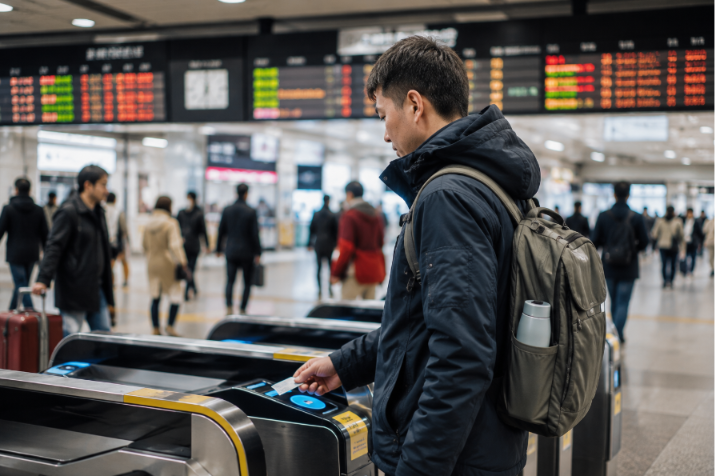
Getting Yen With a Foreign Card
- 7-Eleven (Seven Bank) ATMs: the most reliable for foreign Visa, Mastercard, Maestro and Cirrus cards. The fee is usually ¥110 to ¥220 per withdrawal, plus whatever your own bank charges. The limit is typically ¥100,000 per transaction, and your card also has its own daily limit.
- Japan Post ATMs: also accept foreign cards reliably. Lawson and FamilyMart ATMs accept many foreign cards too.
- Bank ATMs: most Japanese bank branch ATMs do not accept foreign cards, so do not waste time at them.
- Airport and money-changer counters: usually worse rates than an ATM withdrawal
Where You Still Need Cash
- Small restaurants, local markets and some family-run shops
- Vending machines, coin lockers and shrine or temple offerings
- Capsule toys, which cost ¥200 to ¥500 each
- Rural areas, where card acceptance is thinner
- Mountain trips: trailhead buses, huts, ropeways and campsites often take cash only, so check before you go
If you are heading into the mountains, carry extra cash and small notes. Our guides to Mount Hakuba, Mount Takao and the Hakkoda Mountains list transport and hut costs that are easiest to pay in yen.
Coins deserve a mention because they add up fast. Japan uses six coin denominations, and the ¥500 coin is the largest, so a small coin purse helps. Shrine offerings and goshuin (temple and shrine stamp) fees are paid in cash, and a ¥5 coin is traditionally tossed into the offering box for good luck. Some older station lockers still accept only coins, while newer ones take IC cards.
Cards, IC Cards and Phones
A rechargeable IC card such as Suica, PASMO or ICOCA covers trains and buses and also pays at convenience stores, vending machines and many coin lockers, which means fewer coins in your pocket. It is not a substitute for cash, though. One 2026 guide notes that many places that refuse credit cards also refuse IC cards, and most station top-up machines accept only cash, so even a card-heavy traveller needs some yen to keep the IC card working.
For cards, Watabi estimates a foreign transaction fee of roughly 1.5% on top of the daily rate, which is why a card with no foreign-transaction fee is worth having. Cards are accepted at most convenience stores, major retailers and hotels in big cities, although Wise notes that contactless card payments are still relatively uncommon in Japan. Keep one ¥10,000 note separate from your main wallet as an emergency fallback in case a terminal or ATM fails.
Tax-Free Shopping and Tipping
Japan’s consumption tax is 10%, or 8% for food and drink taken away. Most shop prices already include it. Visitors can claim a refund on tax-free purchases above a ¥5,000 pre-tax threshold, and the process is changing, so ask at the register how it works this year.
You never tip in Japan, and attempts to do so are often refused. Many shops will ask you to place cash on a small tray at the register instead of handing it over, which is normal and not a sign of rudeness.
Practical Tips
- Japanese notes come in ¥1,000, ¥5,000 and ¥10,000 denominations. All three were redesigned in July 2024, so you may see old and new notes in circulation
- Use a card with no foreign-transaction fee and decline the option to pay in your home currency
- An IC card such as Suica covers trains and many small purchases, so you carry less cash
- Check your bank’s own ATM fee and daily limit before you travel
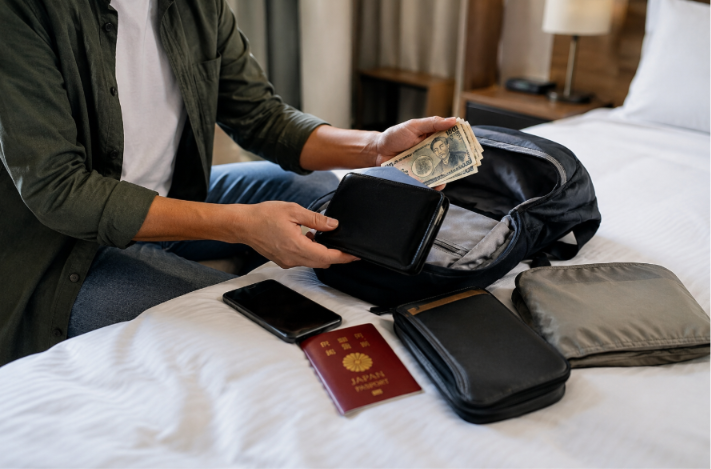
Yen FAQ
Should I exchange money before I leave?
You do not need to. Most guides recommend withdrawing yen from a 7-Eleven ATM after you land, which usually gives a rate close to the market rate.
Do credit cards work everywhere?
Acceptance has improved a lot, especially in large cities, but foreign cards are not accepted everywhere. Carry a mix of cash and cards.
Is it safe to carry cash?
Japan is generally safe, but losing a large sum can still ruin a trip. Carry what you need and top up as you go.
Can I travel in Japan completely cashless?
Not entirely. Guides agree that you can handle most spending in big cities with a card, a phone wallet or an IC card, but temple and shrine fees, street vendors, small restaurants, older coin lockers and rural buses still need yen.
Do I need to tip in Japan?
No. Tipping is not part of Japanese culture and is not expected in restaurants, taxis or hotels. Leaving money on the table can cause confusion, and staff may try to hand it back.
Can I get a tax refund as a tourist?
Yes, on purchases above the ¥5,000 pre-tax threshold at registered tax-free shops, with your passport. Watabi reports that the system is changing to a refund-at-departure model from around November 2026, so check how the shop handles it before you pay.
How much extra cash should I carry on a mountain trip?
Enough for trailhead buses, hut or campsite fees, ropeways and a meal at the end, in small notes and coins. Transport and hut operators in mountain areas often do not take cards, so carry more than your usual daily amount. Check each operator’s payment options before you leave the last town with an ATM.
Sources and Last Check
We compiled this guide from published 2026 money guides, not from our own spending logs. We last checked these sources on October 9, 2026. Fees, limits and rates change, so confirm them with your bank and the ATM operator. Images are illustrations.
- Japan Travel Kit: How much yen to bring, 2026
- MileAsia: Japan money guide 2026
- Tiny Tot in Tokyo: How much cash to bring to Japan
- You: Japan ATM withdrawal guide 2026
- Boutique Japan: Money in Japan
- Watabi: How to pay in Japan 2026
- GLT: Do you need cash when traveling in Japan?
- Tunex Travels: How much money to bring to Japan
- Japan Activity: Japan money guide 2026
- Wise: Cash or card in Japan
- MileAsia: Japan money guide 2026
