
First, a clarification that saves a lot of confusion: the “Hakkoda Tunnel” is not a hiking destination. It’s a 26.4-kilometer railway tunnel carrying the Tohoku Shinkansen under the Hakkoda Mountains — trains pass through it in the dark, and no, you cannot walk through it. If you came here looking for a tunnel hike, this is the moment to adjust your plans.
What you actually want is the Hakkoda Mountains themselves: a volcanic mountain range in Aomori Prefecture, at the northern tip of Honshu, famous for three things. In winter, the slopes grow juhyo — “snow monsters,” trees so completely encased in snow and ice that they become towering white sculptures. Year-round, the Hakkoda Ropeway carries you from the valley floor to near the summit of Mt. Odake (1,585 m) in about ten minutes. And at the foot of the mountains sits Sukayu Onsen, a hot spring inn around 300 years old, home to one of Japan’s most famous mixed bathing halls.
This guide covers the mountains as they deserve to be covered: how to get there from Tokyo, what the ropeway ride is like, when to come for snow monsters versus autumn color versus summer hiking, and the practical details that make or break the trip.
Table of Contents
- Quick facts
- Getting there
- The ropeway: the easiest way up
- Winter: the snow monsters
- Summer and autumn: hiking
- Sukayu Onsen: the mountain’s great bathhouse
- A note on the mountain’s history
- What to pack
- Where to stay
- Our tips
- How We Would Plan Hakkoda by Season
- Frequently asked questions
- Final thoughts
Quick facts
| Place | Hakkoda Mountains, Aomori Prefecture, northern Honshu |
| Main peak | Mt. Odake, 1,585 m |
| Signature experiences | Hakkoda Ropeway (~10 min ride); juhyo snow monsters in winter; Sukayu Onsen |
| Difficulty | Easy as a ropeway sightseeing trip; moderate as a summit hike |
| Time needed | Half a day for ropeway + walks; a full day with Sukayu Onsen |
| Best season | Late Dec–late Mar for snow monsters; late Sep–mid Oct for autumn color; summer for hiking |
| Access summary | Shinkansen to Shin-Aomori (~3–3.5 h from Tokyo), then JR Bus to the ropeway (~55 min) |
Getting there
Tokyo to Aomori
The journey starts on the Tohoku Shinkansen. From Tokyo Station, take a Hayabusa or Hayate service bound for Shin-Aomori — the ride takes roughly 3 to 3.5 hours. This is a long but comfortable trip straight up the spine of Honshu, and it’s fully covered by the Japan Rail Pass if you have one. Book a reserved seat in winter and holiday periods; the Hayabusa in particular fills up.
Shin-Aomori / Aomori to the ropeway
From the Shinkansen terminus, transfer to the JR Bus “Mizuumi-go” service, which runs from both Shin-Aomori Station and Aomori Station up into the mountains. The ride to the Hakkoda Ropeway stop takes about 55 minutes. Buses are not extremely frequent, so check the timetable in advance and plan your return the same way — missing the last bus down leaves you with an expensive taxi ride or an unplanned night in the mountains.
If you’re driving, the mountains are reached via Route 103 from Aomori city. In winter, this road demands proper snow tires and winter-driving experience — the Hakkoda area gets some of the heaviest snowfall in Japan, and conditions change fast.
The ropeway: the easiest way up
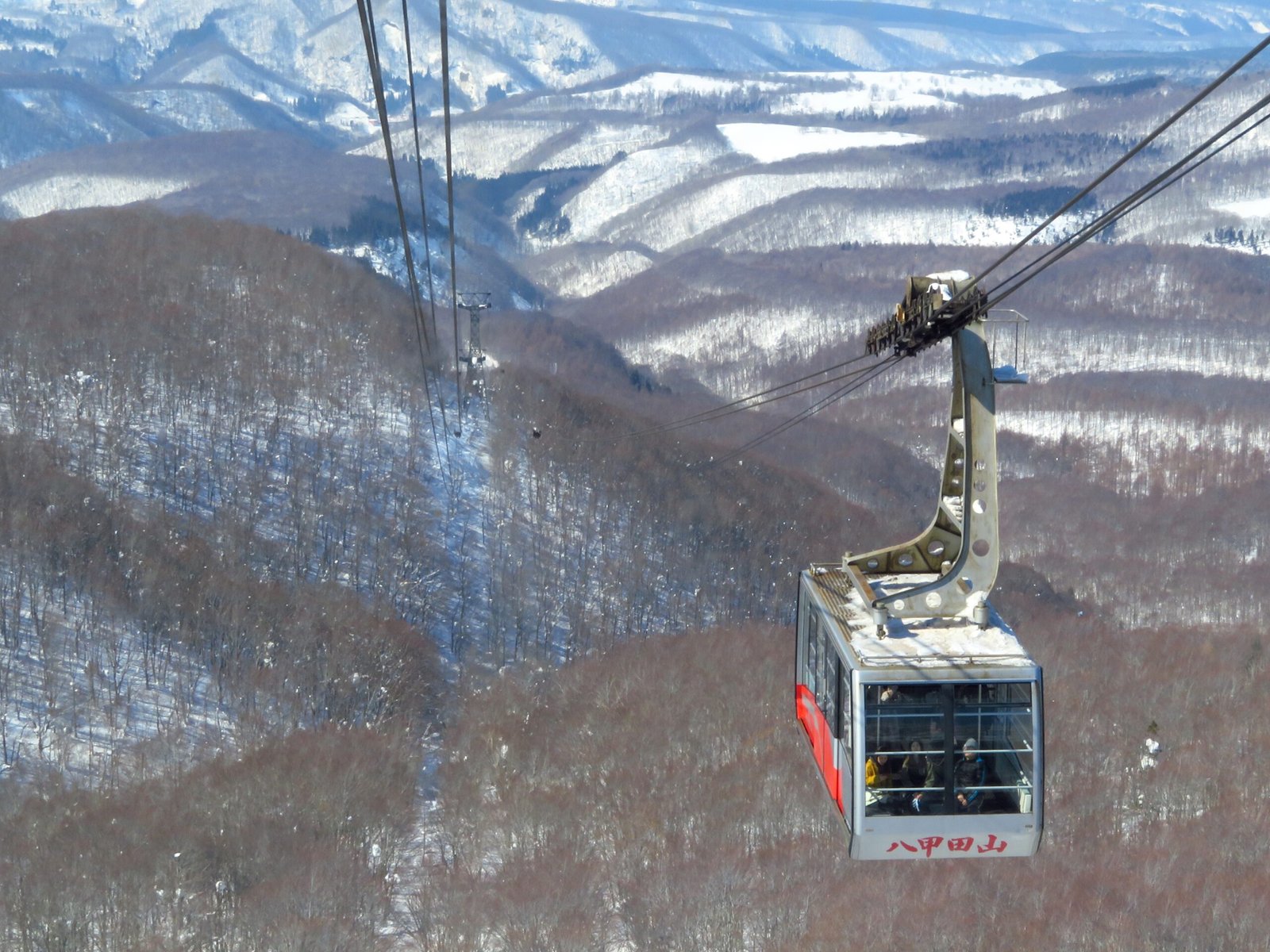
The Hakkoda Ropeway is the centerpiece of most visits. The gondola climbs from the valley station to near the summit of Mt. Tamoyachi in about ten minutes, rising through forest that changes completely with the season — green in summer, blazing color in autumn, and a white-out world of snow monsters in winter.
An adult round trip costs around ¥2,000–2,200 — but verify the current fare on the official site (hakkoda-ropeway.jp) before you go, as prices are revised periodically. At the top station, observation decks and short walking paths let you take in the panorama: on clear days you can see across to the Tsugaru Peninsula and even Hokkaido.
One important caveat: the ropeway suspends operations in high wind, and the summit of the Hakkoda range is famously windy. This isn’t a rare event — it’s a regular feature of the mountain. Check the ropeway’s operating status on the morning of your visit, and have a backup plan (Sukayu Onsen below is the perfect one) in case the gondolas aren’t running.
Winter: the snow monsters
From late December to late March, Hakkoda becomes one of the great winter spectacles of Japan. Moisture-laden wind from the Sea of Japan dumps enormous quantities of snow onto the trees near the summit, where it freezes into thick armor of snow and ice. The result is the juhyo — “snow monsters” or “frost-covered trees” — whole forests transformed into crowds of towering white figures.
The classic way to see them is from the ropeway, which carries you straight through the juhyo zone, plus the short walks around the upper station. Late January through February is generally the peak of the formations, when the monsters are at their largest. Go on a clear, calm morning if you can: in a whiteout, you’ll be inside a snow globe with nothing to see, and the ropeway may not run at all.
Dress for serious cold. The summit area in midwinter is far colder and windier than Aomori city, and you’ll be standing around on exposed observation decks. This is full winter-gear territory: insulated jacket, windproof shell, warm hat, gloves, and boots with grip.
Summer and autumn: hiking
When the snow melts, Hakkoda becomes a proper hiking destination. Mt. Odake (1,585 m), the highest peak in the range, is the main objective. Trails lead up through alpine wetlands and volcanic terrain, and the ropeway gives you a head start if you want to shorten the climb.
Be honest with yourself about the difficulty: this is a real mountain hike, not a stroll. The weather at the top can turn quickly even in summer, the trails are rocky in places, and you should allow several hours for a summit trip. Start early, carry rain gear and warm layers regardless of the forecast, and turn back if the cloud closes in — navigation on the upper mountain in fog is no place for guesswork.
For walkers who don’t want the full summit, the areas around the ropeway stations and the wetlands below offer shorter, gentler options with plenty of alpine flowers in summer.
Autumn color
From late September to mid-October, the Hakkoda slopes ignite in autumn color — one of the earliest and most celebrated foliage seasons in Honshu. The contrast of red and gold forest against the volcanic peaks, seen from the ropeway, is spectacular. This is the second peak season after winter, so expect crowds on fine weekends and book transport and accommodation ahead.
Sukayu Onsen: the mountain’s great bathhouse
No Hakkoda trip is complete without Sukayu Onsen, sitting at the foot of the mountains a short distance from the ropeway. The inn is around 300 years old, and its claim to fame is the sennin-buro — the “bath of a thousand people” — a vast wooden bathing hall and one of the most famous mixed-gender baths in Japan.
Yes, it’s mixed bathing, and yes, that surprises many first-time visitors. It’s also entirely normal here: bathers are expected to behave with complete decorum, and the atmosphere is matter-of-fact rather than awkward. If mixed bathing isn’t for you, the inn also has separated bathing times and facilities — check the current arrangements when you visit.
The water is a milky, sulfur-rich hot spring, and after a cold day at the summit — or as a consolation prize when the ropeway is winded off — there’s nothing better. Even if you’re not staying overnight, day-use bathing is typically available.
A note on the mountain’s history
Hakkoda carries a somber piece of Japanese history: in January 1902, a military snow march in these mountains was caught by a blizzard, and 199 of the 210 soldiers died — one of the worst mountaineering disasters in history. It’s remembered in Japan as a lesson in respecting winter mountains. When the ropeway staff suspend operations for wind, or when locals tell you the weather up top is not to be trifled with, this is the history behind their caution. Take it seriously.
What to pack
- Winter (Dec–Mar): full insulated winter gear — down or synthetic insulated jacket, windproof shell, thermal base layers, warm hat, insulated gloves, and boots with solid grip. The summit is brutally cold and windy.
- Summer hiking: rain jacket and rain pants, warm mid-layer, sturdy hiking boots, 1.5–2 liters of water, food, headlamp, and a map. Weather changes fast at 1,585 m.
- Autumn: layers plus a windproof shell; mornings at the summit station can be near freezing even when Aomori city is mild.
- Year-round: cash for bus fares and the ropeway, a towel if you plan to use Sukayu’s baths, and sunglasses — snow glare in winter is intense.
Where to stay
Sukayu Onsen itself is the most atmospheric place to stay — waking up in the mountains with the great bath downstairs is an experience, not just a bed. Book well ahead for winter weekends and foliage season. Otherwise, Aomori city offers the full range of business hotels and is under an hour from the ropeway by bus, making it a practical base if you want restaurants and options in the evening.
Our tips
- Check the ropeway status before you leave your hotel. Wind suspensions are common, not exceptional. The official site posts operating status — look before you commit to the bus up.
- Plan around the bus timetable. The Mizuumi-go doesn’t run every few minutes. Know your return bus time before you ride up, especially in winter when daylight is short.
- For snow monsters, prioritize a clear morning. The formations are best in bright light, and whiteout conditions mean you’ll see nothing from the gondola. If the forecast is poor, shift your mountain day.
- Verify the ropeway fare before you go. Budget around ¥2,000–2,200 for an adult round trip, but confirm on hakkoda-ropeway.jp — mountain transport prices change.
- Pair the mountain with the bath. Ropeway in the morning, Sukayu Onsen in the afternoon is the classic Hakkoda day, and it means a winded-off ropeway doesn’t ruin your trip.
- Respect the 1902 lesson. If staff say conditions are bad, believe them. The mountain has earned its reputation.
How We Would Plan Hakkoda by Season
| Season | What we would do | Why |
|---|---|---|
| Late December to late March | Ride the ropeway on a clear, calm morning, then soak at Sukayu Onsen in the afternoon | Juhyo are at their largest from late January through February, and a whiteout means you see nothing |
| Summer | Hike Mt. Odake early, or keep to the wetlands and short walks near the ropeway stations | The summit hike is a real mountain day and weather can turn quickly at 1,585 m |
| Late September to mid-October | Visit on a weekday and book transport and a room ahead | This is the second peak season, with early autumn colour and weekend crowds |
With about 3 to 3.5 hours on the Shinkansen to Shin-Aomori plus roughly 55 minutes on the bus, we would not try Hakkoda as a day trip from Tokyo. We would stay a night in Aomori or at Sukayu Onsen, so the ropeway morning and the onsen afternoon both fit, and so a wind suspension does not ruin the trip. We would also write down the last bus down before riding up, as this guide advises.
For the ropeway and skiing side in more detail, see our Hakkoda Ropeway guide, and for another snowy region, Myoko Kogen.
Frequently asked questions
Can you walk through the Hakkoda Tunnel?
No — and this is the most important thing on this page. The Hakkoda Tunnel is a 26.4-kilometer railway tunnel used by the Tohoku Shinkansen. It is not walkable, not visitable, and not a hike. The Hakkoda Mountains above it are the destination.
When is the best time to see the snow monsters?
The juhyo season runs from late December to late March, with the formations typically at their most impressive from late January through February. Go on a clear, calm morning for the best views — and the best chance the ropeway is running.
Does the ropeway run in bad weather?
Not in high wind. Suspensions are frequent in winter and possible year-round, since the summit ridge is exposed. Always check the operating status on the day, and keep Sukayu Onsen as your backup plan.
Is Sukayu’s big bath really mixed?
Yes — the famous sennin-buro is a mixed-gender bath, and it has operated that way for generations. Etiquette is strict and the atmosphere is respectful. If you’d rather not, the inn provides separated bathing options; check the current schedule when you visit.
Can beginners hike in the Hakkoda Mountains?
As sightseers, absolutely — the ropeway and the short walks at the top need no hiking experience. As a summit hike, Mt. Odake (1,585 m) is a real mountain undertaking: allow several hours, carry proper gear, and watch the weather. The wetlands and lower trails offer a middle ground for casual walkers in summer.
What happened here in 1902?
In January 1902, an Imperial Japanese Army snow march in the Hakkoda Mountains was trapped by a blizzard; 199 of 210 men died. It’s commemorated in Japan as a warning about winter mountains — and it’s why locals and ropeway staff take weather warnings so seriously today.
Final thoughts
The Hakkoda Mountains reward travelers who come for the right reasons: the strange white forests of winter, the ten-minute ride above them, the autumn fire on the slopes, and the steam rising off a 300-year-old bathhouse at the end of the day. Just don’t come looking for a tunnel hike — the only tunnel here carries bullet trains, and the mountains above it are far more interesting anyway. For more single-day mountain ideas elsewhere in Japan, see our best one-day hikes in Japan roundup.

2 thoughts on “Hakkoda Mountains: Ropeway, Snow Monsters & Hiking Guide”