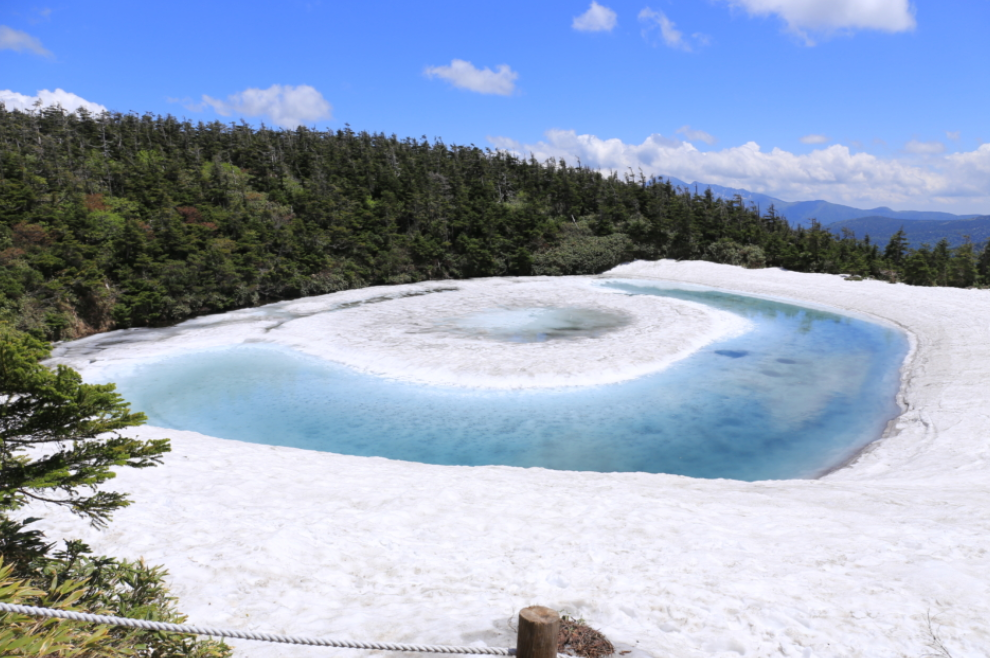
Kagami Numa Lake is located near the summit of Mount Hachimantai in the border area between Iwate and Akita prefectures. It is one of the most spectacular and rare natural phenomena, visible only during a specific season. The serene alpine water body lies undisturbed throughout much of the year, under a blanket of mountain underbrush and winter snow. In a short two-week season in late spring, when the ice melts, the basin becomes the world-famous “Dragon Eye” (Ryu-no-me).
In spring, when the sunlight glints on the edges of the snowdrift, leaving a frozen eye in the middle like a pupil, Kagami Numa Lake presents a striking and gigantic blue-and-white eye looking up at the sky. Towada-Hachimantai National Park is a popular destination for outdoor enthusiasts, offering a glimpse into this optical phenomenon.
Table of Contents
- Story about geography and the science behind the Dragon Eye
- Understanding these dynamic forces to visit Kagami Numa Lake
- Step 1 – Keep an eye on the thaw and time your visit
- The key to planning a trip to witness the Dragon Eye phenomenon is good timing.
- Step 2: Choose Your Favourite Trail Strategy and Route
- Step 3: Ensure regional transportation and road conditions
- Step 4: Pack Equipment specifically for Snowmelt & Cold Alpine Air
- Step 5: Do the Trail Navigation Safely.
- Step 6: Practice Environmental Conservation
- Route Summaries and Profiles
- Best Seasons to Visit
- Planning to Travel in the North of Japan.
Story About Geography and the Science Behind the Dragon Eye
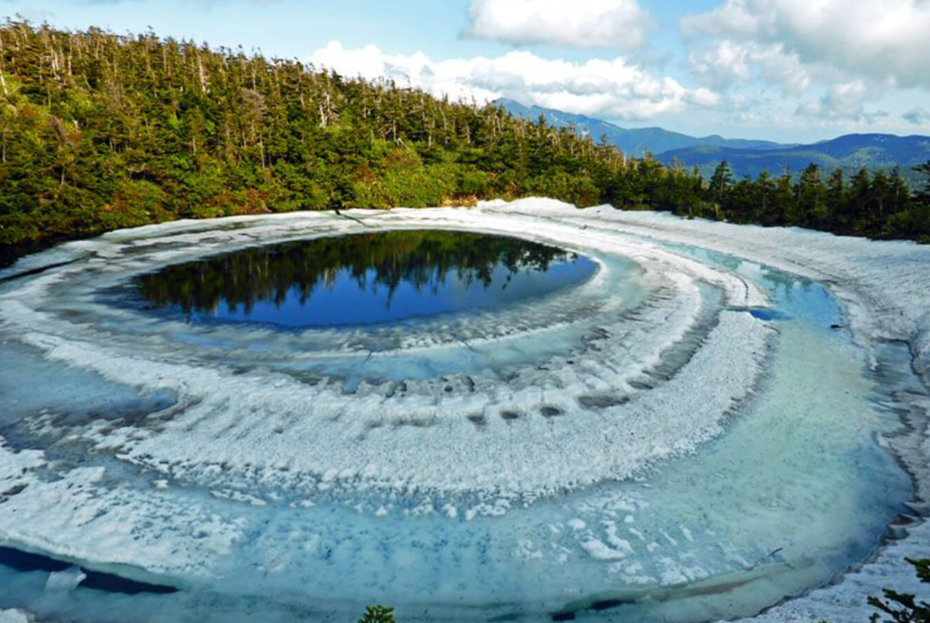
Knowing the special geology and atmosphere of the area will help you understand why Kagami Numa Lake is so ephemeral.
The lake is located in a volcanic crater pond (caldera) at an elevation of around 1580 m, where the ancient volcanic eruption activity of the Hachimantai volcanic plateau has created a circular volcanic crater.
Snow Accumulation Phase: Heavy winter storms bring meters of heavy snow to the Towada-Hachimantai range, and the lake is covered in a deep, compact snowpack.
The Spring Thaw Mechanism: Geothermal heat from the caldera below acts in concert with an increase in air temperatures in late May/early June. Due to the water pressure, it detaches from the bottom and floats. The first snow to melt is along the shore, forming a dark blue ring around the shore, and the last snow to melt is in the centre, forming a “pupil” in the shape of a circle.
The Emerald Tint: The light from the sun shines through the transparent meltwater over the dark volcanic lake bed, creating a beautiful turquoise, cyan, and emerald green ring around the lake.
Understanding these Dynamic Forces to Visit Kagami Numa Lake
Step-by-Step Method: How to Carry Out a Risk-Free and Effective Trip
When visiting a high-elevation wetland habitat during the spring thaw, it is important to plan, use the right equipment, and treat the fragile alpine land with care. Use the following 7 safety steps to make your trip safe.
Step 1: Keep an Eye on the Thaw and Time
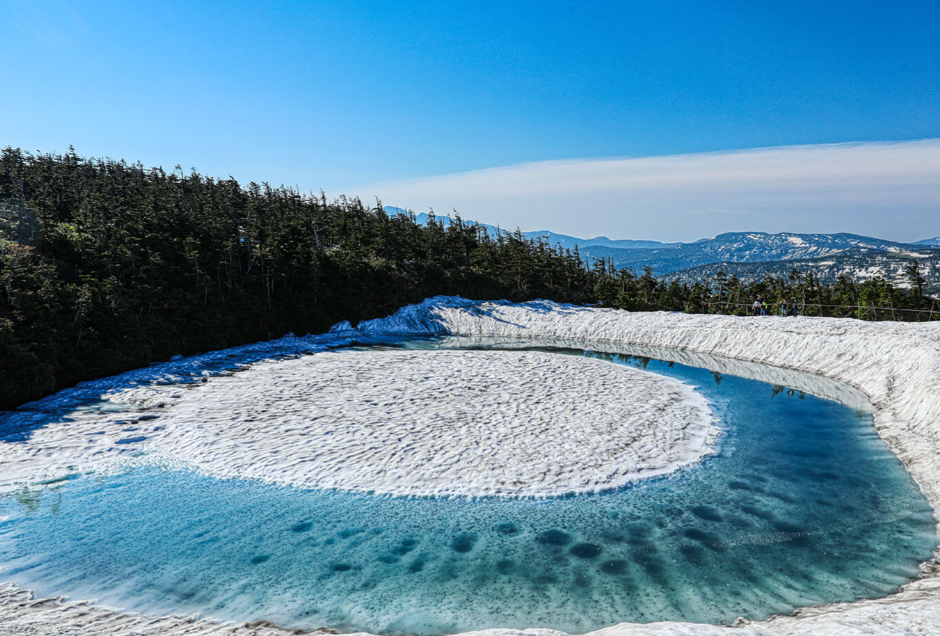
The period of time to witness the complete form of the Dragon Eye at Kagami Numa Lake is generally just 10-14 days from late May to early June. Please refer to the trail reports and social media information from the Hachimantai Visitor Centre before leaving for the trail. If you come too early, it is a continuous white snow field, and if you come too late, the central ice path breaks and melts.
Step 2: Choose Your Favourite Trail Strategy and Route
Select a walking route that is appropriate for your time, equipment, and fitness.
Option A: The Hachimantai Summit Loop (Easy – 1.0 to 1.5 Hours) is probably the most popular route, beginning at the parking lot of the Hachimantai Rest House. A paved and well-maintained wooden boardwalk loop, this 2.5-kilometre walk leads through Kagami Numa Lake, Megane Numa and the official Mount Hachimantai lookout tower.
Option B: The Goshiki Numa Pond Traverse (Moderate – 2.5 to 3.5 Hours): A longer loop that explores more of the primary summit area and then goes beyond to look at some of the other ponds, primeval beech forests and marshlands.
Making your route choice ahead of time helps to keep your party organised and on track.
Step 3: Ensure Regional Transportation and Road Conditions
In late spring, it’s important to check road conditions and travel times when driving over mountain passes.
The main road, Hachimantai Aspite Line, is a beautiful mountain road between Iwate and Akita prefectures. In late April, when the snow has been cleared, the highway becomes open to traffic and can often be lined with large snow walls along the road shoulders. Cars will be able to park right at the mountain pass, Hachimantai Rest House. Or use seasonal bus service for each season going from JR Morioka Station (Iwate side) or JR Tazawako Station (Akita side) to the summit bus stop.
Step 4: Pack Equipment Specifically for Snowmelt & Cold Alpine Air
In the spring at 1,500+ meters: rapidly changing weather and slippery, icy conditions.
The area around Kagami Numa Lake is still in snow slush with packed snow during peak viewing hours, so be sure to wear waterproof hiking boots with good ankle support and a good tread. Put micro spikes or light crampons on boots to hold onto icy slopes. Wear a base layer that is moisture-wicking, a fleece or down jacket for warmth, and a windproof/waterproof outer shell. Pack sunglasses to help with the snow glare at high altitudes, trekking poles for balance, and a water bottle.
Step 5: Do the Trail Navigation Safely
Follow the trail, develop the skill of good footwork, and keep an eye on the weather.
At the Hachimantai Rest House, the trail is clearly indicated with directional signs towards the Dragon Eye and the trail to the top. It’s about a 15- to 20-minute walk to the lake, up a gentle slope. If there is springtime mountain fog, walk slowly on the plateau, keeping to trail markers to avoid becoming disoriented on snow-covered trails.
Step 6: Practice Environmental Conservation
It is very important to follow outdoor ethics in order to preserve the Towada-Hachimantai National Park.
Do not leave the trail or walk on the surface of the melting Kagami Numa Lake. The ice sheet is thin and unstable; it is very dangerous. Keep within wooden safety ropes and barrier flags to avoid damaging sensitive alpine vegetation, including plants that are blooming, e.g., Mizubasho (Asian skunk cabbage) and the alpine lilies emerging along the retreating banks. Take out all rubbish; do not alter the natural environment.
After all the aforementioned steps, you may enjoy relaxing in the local Hachimantai Onsen villages.
End your trip in the mountains with a taste of the abundant geothermal hot springs around the mountain base.
Route Summaries and Profiles
Hachimantai Summit Dragon Eye Loop
Stats: 2.5 km | ~1.0 to 1.5 Hours | Elevation Gain: 90 m | Level: Easy-Moderate
Platforms for Dragon Eye viewing: direct, summit, and Megane Numa.
Hachimantai Marshland Traverse 1 – Extended
Conditions: 6.0 km / ~3.0 Hours / Elevation Gain: 210 m Up / Level: Moderate
Best Seasons to Visit
Winter (Early August to Late August)
It’s the only opportunity to see the legendary Dragon Eye effect. A melting icy lake stands in stark contrast to crisp air, hanging snow walls along the Aspite Line, and bright blue skies.
The Summer Months (July-August)
When the ice finally breaks up, the lake becomes a tranquil, clear volcanic lake, set amidst plentiful beech trees and dazzling wildflowers. Summer is a great time to travel leisurely.
Fall or Late September to October
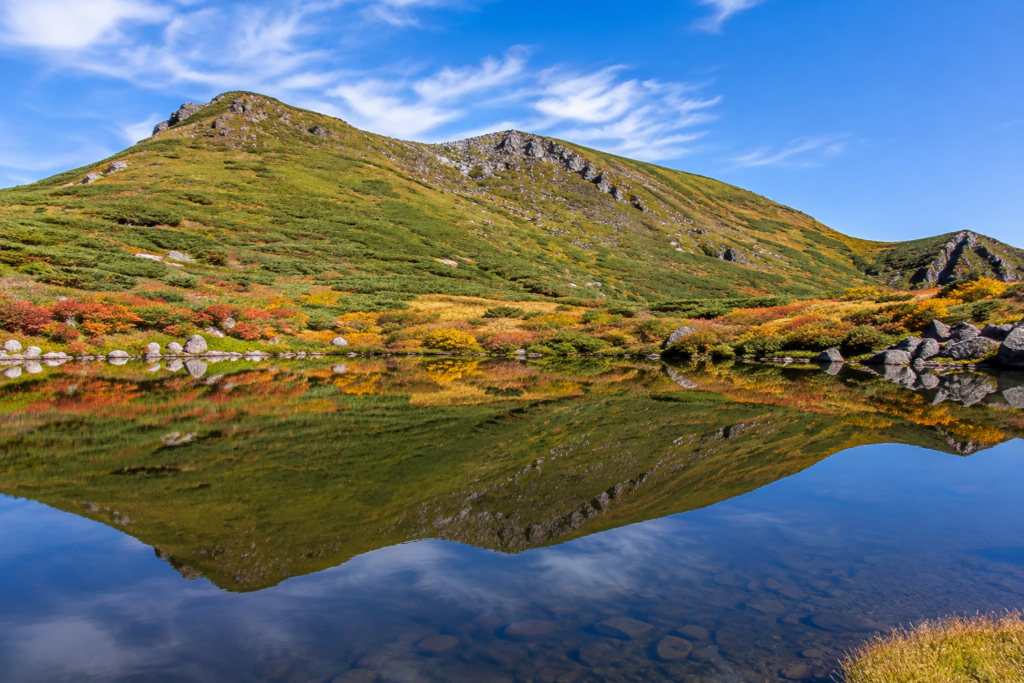
The Hachimantai plateau is a dazzling array of red, gold, and deep orange in the fall. Fall foliage season is the best time to drive the Aspite Line for some of the best views of the mountains in northern Japan.
The Winter Months (November to April)
High mountain roads shut when there is a lot of snow. All across the plateau, it freezes, creating a snow-covered snowshoeing and backcountry skiing wonderland for the seasoned winter adventurer.
Planning to Travel in the North of Japan
Kagami Numa Lake offers a unique experience, a world phenomenon, great trails up the hill, and relaxing geothermal hot springs. With precise timing, the right equipment, and a healthy dose of common sense, your journey to the Dragon Eye should be a smooth, safe, and memorable experience.
